Manufacture of fasteners by cold heading
The manufacture of fasteners by cold heading has established itself as one of the most efficient and precise processes in the metallurgical industry. Thanks to this technique, it is possible to produce screws, bolts, rivets and special parts with a level of strength and finish that is difficult to achieve with other methods. In an increasingly demanding industrial market, this technology represents the perfect combination of productivity, cost savings and final quality.
What are fasteners?
Fasteners are essential components in any industry, designed to join parts, structures or components either temporarily or permanently. Also known as cold formed fasteners or cold headed fasteners depending on the manufacturing method used, these elements ensure that assemblies hold together, support loads, resist vibrations and meet strict design specifications. From the construction of a building to the assembly of an electronic device, fasteners are the foundation that guarantees stability, safety and proper functioning across countless products and industrial systems.
Their proper choice is crucial to the durability and performance of the final assembly, so their precise and robust manufacture, such as that offered by cold heading, is of vital importance.
Materials most commonly used in the manufacture of fasteners by cold heading
One of the most important factors in the manufacture of fasteners is the choice of material.
- Cold heading steel: provides hardness, mechanical strength and durability, making it perfect for high load bearing fasteners.
- Aluminum cold heading: offers light weight and corrosion resistance, characteristics highly valued in sectors such as automotive, electronics or light construction.
The choice between steel or aluminum depends on the final application: while a steel screw can guarantee structural safety, an aluminum screw reduces weight without sacrificing efficiency.
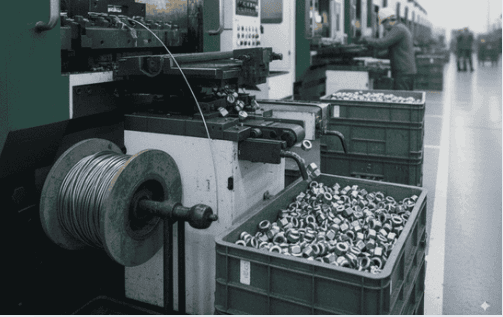
Types of common fasteners
Screws
Screws are threaded elements designed to attach to a material, creating an internal threaded joint or coupling with a nut. They are characterized by a threaded shank and a head that allows torque to be applied for insertion or removal. They are essential for temporary or permanent assemblies, offering great versatility in the industry.
Nuts
Nuts are parts with an internal thread that attach to the threaded shank of a screw or bolt. When turned, they exert pressure against the clamping surface, securing the connection between components. They come in various shapes and designs, including safety variants to prevent loosening due to vibration.
Rivets
Rivets are permanent fasteners that join two or more parts together through plastic deformation of one or both ends. Once installed, they cannot be removed without damaging the rivet or the bonded materials. They are widely used in applications where high mechanical strength and an immovable bond are crucial.
Pins
Pins are cylindrical or tapered elements that are inserted into matching holes to align, position or fix components. They are often used to transmit shear forces or to prevent relative movement between parts. Their simple design makes them ideal for precision applications or as safety features.
Washers
Washers are flat pieces, usually circular, which are placed under the head of a bolt or nut. Their main function is to distribute the clamping load over a larger surface area, protecting the part material and preventing loosening. There are also lock washers designed to resist vibrations.
Bolts
Bolts are cylindrical fasteners without threads along their entire length or with threads at one end, designed to be used with a nut. They are usually more robust than bolts and are used in joints where higher tensile and shear strength is required. They are common in construction and heavy machinery.
Need help?
Contact our technical office and tell us about your project.
We will study your case and propose a solution to manufacture them.
Types of processes for the manufacture of fasteners by means of cold heading
The manufacture of fasteners relies on different forming techniques, each suited to specific levels of complexity and production volume. Cold heading (also widely referred to as cold forging or cold forming) is the most efficient method for producing high volumes of fasteners with tight tolerances and excellent mechanical properties. Understanding the differences between cold forging fasteners processes helps engineers and purchasing managers select the right approach for each project:
- Simple stamping: ideal for basic geometry fasteners produced in a single die operation.
- Progressive stamping: allows several operations to be carried out sequentially on the same die, speeding up production of standard fasteners such as screws and pins.
- Multi-station cold heading: an advanced method that manufactures complex cold formed parts in different work phases, optimizing cycle times and reducing material waste. This is especially relevant for producing high-precision bolts, industrial rivets and specialty fasteners.
Step-by-step process: how we manufacture high quality fasteners
The cold heading process follows a rigorous sequence designed to guarantee precision, consistency and mechanical performance across every single part. Each stage of this cold heading manufacturing method is carefully controlled — from raw material input to final inspection — ensuring that every fastener meets the technical standards required by demanding industries.
- Material selection: the type of steel or aluminum is defined according to the end application, considering factors such as tensile strength, corrosion resistance and formability.
- Design and construction of dies: specific tooling is developed for each type of fastener, engineered to achieve the target geometry within tight tolerances.
- Pressing and forming: the cut blank is introduced into the cold heading press, where it is shaped through one or more die stations using controlled mechanical force.
- Additional operations: depending on the fastener, secondary processes such as trimming, bending, threading by rolling or punching may be applied.
- Finishing and quality control: the completed fasteners are verified against the required technical standards to ensure dimensional accuracy, surface finish and batch traceability.
This process makes it possible to obtain large volumes of uniform parts, ready to meet the needs of the most demanding industrial sectors.
Advantages of manufacturing fasteners by cold heading
Choosing cold heading over alternative manufacturing methods offers a clear competitive edge, particularly when producing fasteners and cold formed parts in long series. The combination of speed, precision and material efficiency makes this process the preferred choice for manufacturers who need to balance quality with cost-effectiveness:
- Reduced energy consumption compared to hot stamping, as the process operates at room temperature without the need for furnaces or preheating systems.
- Greater dimensional accuracy, with tolerances that often eliminate the need for secondary machining operations.
- Natural work hardening of the material during forming, which increases the tensile and fatigue strength of the finished part.
- Minimal raw material waste, since the metal is shaped rather than cut — virtually all input material becomes part of the final product.
- Higher production speeds, with modern multi-station presses capable of producing hundreds of parts per minute.
These advantages make cold formed fasteners particularly suitable for industries where unit cost, mechanical reliability and production consistency are critical factors.
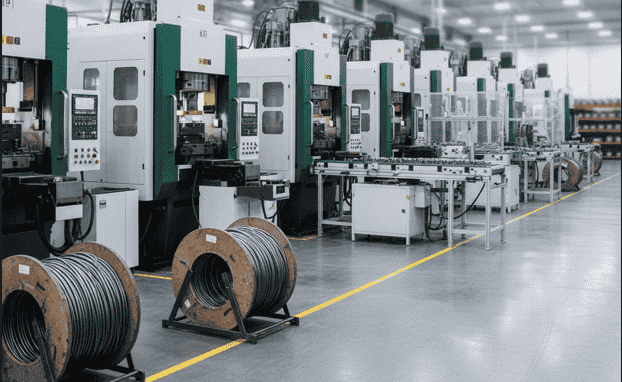
Cold heading of fasteners offers distinct advantages over other methods:
- High production speed.
- Reduced energy consumption compared to hot stamping.
- Greater dimensional accuracy.
- Natural hardening of the material during the process.
- Reduced raw material waste.
Main applications of fasteners
Cold headed fasteners serve a wide range of industrial sectors, each with its own technical demands and quality standards:
Automotive: screws, rivets and specialty fasteners for car bodies, engines, suspension systems and cable terminals. Working with a reliable automotive fastener manufacturer ensures compliance with strict safety and performance requirements across the supply chain.
Aerospace: bolts, rivets, pins and structural fasteners for aircraft fuselages, wings and landing gear. In this sector, partnering with a certified aerospace fastener manufacturer is essential to meet the stringent standards of EN 9100 and other international aerospace regulations.
Electronics: special screws, spacers, contact pins and miniature components that require high dimensional precision and consistent surface finishes.
Construction: high-strength structural bolts, anchors and rivets designed to withstand heavy loads and environmental exposure over long service lives.
Industrial machinery: bushings, shafts, ball joints and custom components that demand robustness, tight tolerances and reliable performance under continuous operation.
Innovation in the manufacture of metal fasteners by stamping
Innovation in cold heading applied to the manufacture of metal fasteners has occurred in two ways, on the one hand in raw materials and on the other hand in more advanced machinery.
Raw materials
Innovation in this field has allowed the development of processes capable of working with ultra-high strength steels (1500 MPa or more), used in automotive components that require maximum safety.
Machinery and dies
Similarly, multi-station stamping has made it possible to manufacture fasteners with increasingly complex geometries, reducing costs and production times without compromising quality. This has been possible thanks to advances in machinery and die development.
How to request production or quotation
If your company needs industrial fasteners by cold heading, it is advisable to contact our technical office so that we can provide you with the best solution:
- Let’s analyze your specific need.
- Select the appropriate material (steel, aluminum, etc.).
- Let’s design the necessary matrices.
- Specify finish grades, tolerances, and lead times.
Get in touch with us
Contact our technical office and tell us what kind of steel parts you need to manufacture.
We will study your case and propose a customized, fast and efficient cold stamping solution.
Frequently asked questions about fastener manufacturing by cold heading FAQ’s
Which fasteners are manufactured by cold heading?
Fasteners manufactured by cold heading are mainly screws, bolts, rivets and special fasteners for many industrial sectors.
Why is it beneficial to use high-performance steels in the manufacture of fasteners by cold heading?
Steel provides mechanical strength, durability and high load-bearing capacity, making it perfect for structural fasteners.
When should aluminum be chosen as a raw material for fastener manufacturing?
Aluminum is often used in the manufacture of metal fasteners when lightness, corrosion resistance and weight reduction are required, especially in the automotive, aeronautics and electronics industries.
What are the main process and application differences between single and multi-station cold heading in fastener production?
Simple stamping is used for basic parts, while multi-station stamping allows complex fasteners to be produced in less time and with greater precision.
Why choose LEMEC for cold heading fastener manufacturing?
Because at LEMEC we have experience, multi-station technology, top quality materials and a team specialized in designing customized fasteners that optimize your production processes.