Stainless steel fasteners: types, uses and applications
We know that there is nothing worse than seeing a rust stain on a recently finished installation. This type of problem does not appear on the first day, but with the passage of time, when corrosion begins to affect both the aesthetics and the durability of the assembly. Choosing stainless steel fasteners is not just a matter of finish; it is the way to ensure that an installation will withstand weathering, wet or chemical environments and continued use without generating unnecessary maintenance costs.
Estampaciones LEMEC, a company specialized in the manufacture of stainless steel fasteners, has developed this article to facilitate the decision between A2 and A4 grades. We provide key technical criteria to avoid common assembly errors and to select the most suitable fastener for each application, thus guaranteeing a safe, long-lasting and justified choice.
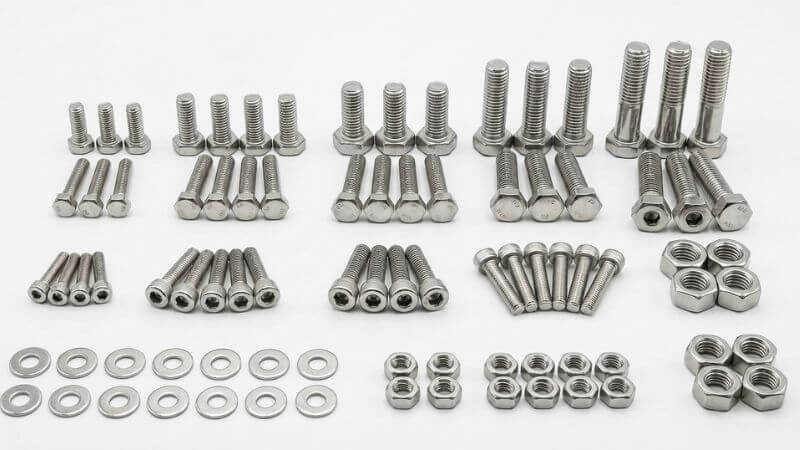
What is stainless steel hardware and why is it more expensive?
Stainless steel fasteners are manufactured from alloys designed to resist corrosion and maintain their integrity over time. Unlike other fasteners protected by surface coatings, its resistance is part of the material itself thanks to the presence of chromium, which generates a passive layer capable of protecting the surface against oxidation even in demanding environments.
This type of steel requires higher quality raw materials and more controlled manufacturing processes, which explains its higher cost compared to solutions such as zinc-coated or galvanized steel. It is not a simple finish, but a material designed to maintain its mechanical behavior, appearance and reliability in humid environments, outdoors or in the presence of chemical agents.
That difference is reflected in the service life of the installation. Stainless steel hardware, or stainless steel as it is known, reduces the need for maintenance, avoids premature replacements and minimizes the risk of failures associated with corrosion. Therefore, although the initial price is higher, it usually becomes a more efficient investment when analyzing the project as a whole and its durability in the medium and long term.
| Criteria | Stainless steel fasteners | Conventional fasteners (zinc plated / galvanized) |
|---|---|---|
| Corrosion resistance | Very high, integrated in the material | Coating dependent |
| Long-term behavior | Stable and predictable | Progressive degradation |
| Need for maintenance | Very low or nonexistent | Medium or high |
| Shelf life | Long | Limited |
| Risk of visible oxidation | Very low | High in demanding environments |
| Initial cost | Higher | Lower |
| Total project cost (TCO) | Optimized for medium/long term | May increase over time |
| Typical applications | Outdoor, industry, aggressive environments | Indoor or controlled environments |
Need help?
Contact our technical office and tell us about your project.
We will study your case and propose a solution to manufacture them.
A2 and A4 fasteners: key technical differences for making the right choice
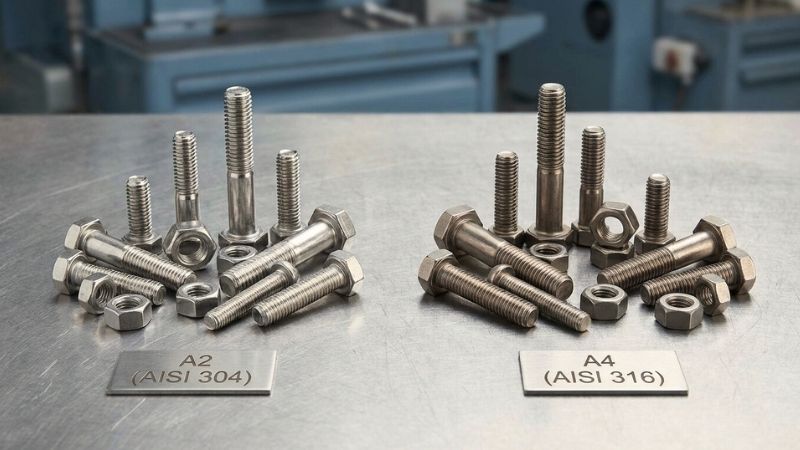
Within stainless steel fasteners, A2 and A4 grades are the most common in industrial and professional applications. Although they share many characteristics, their corrosion performance varies significantly depending on the environment. Understanding these differences is essential to make the right choice without taking unnecessary risks and costs.
What is A2 (AISI 304) fasteners?
A2 fasteners, generally manufactured in AISI 304 stainless steel, are the most commonly used option in standard applications. It offers good corrosion resistance in indoor and moderate outdoor environments, as well as mechanical behavior suitable for most industrial assemblies, technical installations and structures not exposed to aggressive agents.
This type of stainless steel is suitable for environments without the constant presence of chlorides, high salinity or aggressive chemicals. In these conditions, A2 fasteners provide a reliable and durable solution with an excellent cost/performance ratio.
What does A4 stainless steel (AISI 316) provide?
A4 fasteners, based on AISI 316 stainless steel, incorporate molybdenum in their composition. This element significantly improves corrosion resistance, especially against chlorides, marine environments and chemicals, making it the right choice for the most demanding environments.
For this reason, A4 fasteners are commonly used in installations near the sea, swimming pools, chemical, food or pharmaceutical industries, as well as in applications where humidity and corrosive agents are continuously present. In these cases, choosing A4 is not an optional upgrade, but a necessary technical decision to ensure the durability of the installation.
304 vs 316 stainless steel in fasteners: when to use each one
The choice between 304 (A2) and 316 (A4) stainless steel depends directly on the working environment. A2 is sufficient in controlled environments or with moderate exposure, while A4 is essential when aggressive conditions exist that can accelerate corrosion.
Factors such as proximity to the sea, the presence of chlorine, industrial cleaning products, chemical vapors or frequent humidity and drying cycles are determining factors when deciding. Correctly analyzing these variables allows the quality of the material to be adjusted to the actual application, without oversizing or compromising the safety of the installation.
Common errors: overspecifying A4 or failing with A2
One of the most common mistakes is to opt for A4 by default to “play it safe”, making the project more expensive without any real technical justification. Although A4 offers higher performance, it does not always add value in environments where A2 works perfectly well.
The opposite mistake, using A2 in aggressive environments, often has more serious consequences: premature corrosion, rust stains, loss of aesthetics and the need for early replacement. Avoiding both extremes requires a correct assessment of the environment, the expected service life and the cost of possible future intervention, which are key criteria for a successful technical specification.
How to install stainless steel fasteners correctly
Stainless steel fasteners require a different assembly approach than other materials. Its mechanical and surface properties mean that incorrect installation can lead to problems that are not related to the quality of the fastener, but to the way it is tightened and handled during assembly.
Seizure or cold welding: why does it occur in stainless steel?
Seizure is a common phenomenon in stainless steel fasteners and occurs when friction between the threads increases excessively during tightening. As there is no natural lubrication, stainless steel tends to generate micro-adhesions between the screw and nut, causing a blockage that prevents further assembly or disassembly of the fastener.
This effect appears more easily when high tightening speed, lack of lubrication and high torques are combined, and is not indicative of a material defect, but of an inadequate assembly.
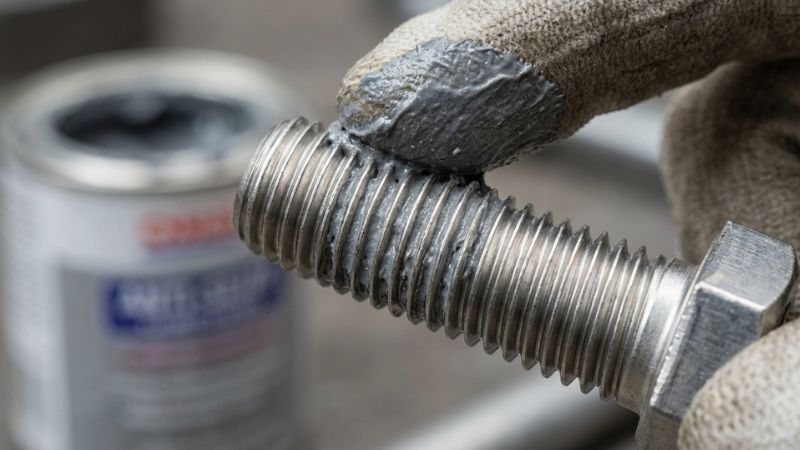
Importance of lubrication and anti-seize pastes
The most effective way to prevent galling is to apply adequate lubrication prior to assembly. Specific anti-seize pastes for stainless steel reduce friction between threads, prevent excessive temperature rise and allow controlled and safe tightening.
In addition to preventing blockages, lubrication improves torque repeatability and facilitates future disassembly or maintenance operations. In critical or difficult to access installations, this step should not be considered optional, but part of the standard assembly procedure.
Tightening torque, assembly speed and best practices
Stainless steel is sensitive to over-tightening and high-speed assembly. Using torque-controlled tools, applying tightening progressively and avoiding sudden impacts or accelerations reduces the risk of seizure and unnecessary stress on the fastener.
Controlled assembly ensures that the fasteners work within the limits for which they were designed, maintaining their reliability over time.
Recommendations for industrial installations and maintenance
In industrial applications, a correct installation of stainless steel fasteners minimizes future interventions and ensures the stability of the assembly. Selecting compatible components, applying adequate lubrication and respecting the recommended tightening torques are practices that make the difference in the durability of the installation.
Types of stainless steel fasteners and when to use each one
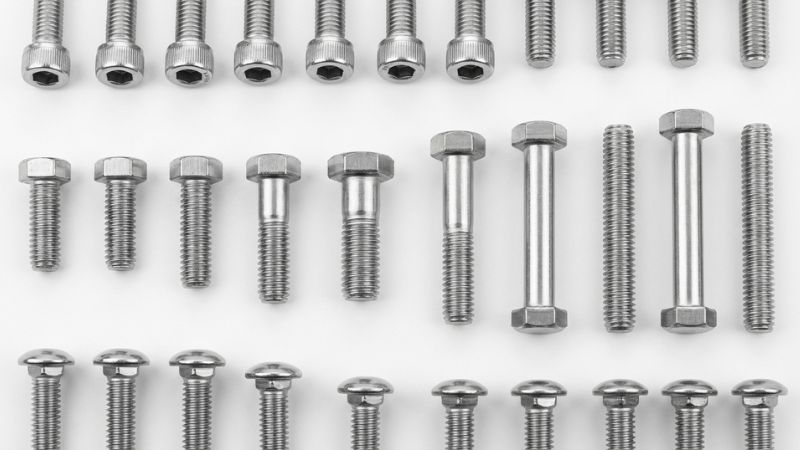
Choosing the right type of fastener is as important as selecting the quality of the steel. The head geometry, the drive system and the way of working directly influence the ease of assembly, the load distribution and the behavior of the fastener over time. The right decision depends on the available access, the required torque and the type of stress to which the fastener will be subjected.
- Allen screws: recommended when controlled tightening is required in tight spaces or when a flush and clean finish is required.
- Hexagonal bolts: the most robust and versatile option for industrial applications, especially when high torques are required.
- Round head screws and other geometries: suitable when safety, aesthetics or surface protection is a priority.
- Standard fasteners vs. custom fasteners: custom manufacturing allows to adapt dimensions and geometries to the actual application, improving reliability and avoiding improvised solutions.
Stainless steel fasteners according to the sector of application
The area in which a fastener works is one of the most decisive factors when choosing stainless steel fasteners. Each sector has different requirements in terms of corrosion, hygiene, maintenance or mechanical stresses, so adapting the solution to the actual context of use is key to ensuring the durability of the installation and avoiding specification errors.
Food and pharmaceutical industry
Stainless steel fasteners in this sector are selected mainly for reasons of hygiene and sanitary safety, in addition to their resistance to corrosion. The fasteners must have smooth, non-porous surfaces, able to withstand frequent cleaning with aggressive chemicals without degrading or generating points of dirt accumulation. A correct choice of material, geometry and finish facilitates compliance with sanitary requirements, reduces contamination risks and minimizes production downtime associated with maintenance or inspections.
Construction, outdoor and aggressive environments
In construction and outdoor applications, fasteners are continuously exposed to moisture, thermal changes and, in many cases, saline or contaminating atmospheres. In these areas, corrosion resistance is critical to prevent the appearance of visible rust, loss of mechanical integrity and aesthetic deterioration of the installation. Stainless steel fasteners allow the structural performance and appearance of the assembly to be maintained over time, provided that the appropriate quality is chosen according to the actual level of exposure.
Automotive, machinery and heavy industry
In sectors such as automotive, industrial machinery or heavy industry, fasteners are often subjected to high mechanical stress, continuous vibration and repeated thermal cycling. In addition to corrosion resistance, it is essential that fasteners maintain stable and reliable mechanical behavior over the long term. Correct specification of stainless steel, together with proper geometry and assembly, helps to reduce loosening, premature failure and unplanned downtime in critical installations.

Suppliers of stainless steel industrial fasteners: what you should require
In industrial applications, the stainless steel fastener supplier is not a mere intermediary. His role directly influences the final quality of the installation, the durability of the assembly and the correct specification of the material. Making the right choice involves going beyond price and assessing technical criteria that provide medium- and long-term security.
Material quality and traceability
A specialized supplier must guarantee the actual quality of the stainless steel supplied and its correspondence with the required technical specification. The traceability of the material makes it possible to know the origin of the alloy, its composition and its consistency with grades such as A2 or A4, which is particularly relevant in sectors where durability, safety or regulatory compliance are critical. Without this control, the risk of receiving unsuitable material increases considerably.
Manufacture of special fasteners and custom-made parts
Not all applications can be solved with standard fasteners. In many industrial projects there are space limitations, specific geometries or mechanical requirements that make custom manufacturing necessary. Having a supplier capable of manufacturing special fasteners makes it possible to adapt the fastening to the actual design of the application, improve assembly and avoid improvised solutions that can compromise the reliability of the assembly.
Technical advice vs. simple supply
The real added value of an industrial supplier lies in its ability to provide technical judgment. Advising on the appropriate quality, type of fastener, environment of use or assembly conditions helps to avoid both unnecessary over-specification and errors that lead to premature failures. Compared to simple supply, technical support provides security in decision making and reduces risks throughout the life of the project.
Manufacture and technical advice on stainless steel fasteners
When the project requires more than a standard solution, having a fabricator who understands the end application is key. LEMEC brings an unusual combination: stainless steel fastener and custom fabrication capabilities, mastery of the cold heading process, and a technical approach to defining each fastener correctly from design.
This way of working makes it possible to adjust material, quality, geometry and tolerances to the actual conditions of use, avoiding both unnecessary over-specification and errors that lead to premature failure. The result is fasteners that fit the application, assemble correctly and maintain their performance over time.
If you need to validate a technical specification, study a tailor-made solution or have a manufacturer who can provide you with criteria from the beginning of the project, you can find more information about the manufacture of stainless steel bolts and special parts
Get in touch with us
Contact our technical office and tell us what kind of steel parts you need to manufacture.
We will study your case and propose a customized, fast and efficient cold stamping solution.