Manufacture of aeronautic rivets by cold heading
In the aeronautical industry, every component must meet the highest standards of quality, strength and precision. Aeronautical rivets are key elements in the structural integrity of both civil and military aircraft, and their manufacturing process is critical to ensure safety and reliability.
In this article we explore in depth the manufacture of these special rivets by cold heading, a technology that Estampaciones LEMEC masters with experience and certifications of the highest level.
Need help?
Contact our technical office and tell us about your project.
We will study your case and propose a solution to manufacture them.
What are aircraft rivets and why are they essential?
Rivets used in aviation differ from conventional rivets in their design, materials and tolerances. They function as semi-permanent joints that resist shear stresses and extreme vibrations, ensuring the structural stability of fuselages, wings and other critical components.
The choice of a suitable rivet directly impacts aerodynamics, overall aircraft weight and stress distribution. This is why international standards such as EN 9100:2018 regulate everything from design to product traceability.
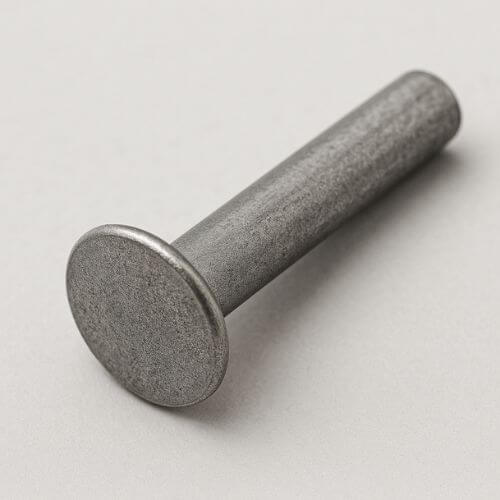
Types of rivets used in aeronautics, aerospace and defense
The most common in this sector include:
- Solid shank rivets: traditional, high strength, used where both sides are accessible. Their installation requires specialized equipment and experience, as they must deform plastically without compromising the structure. They are widely used in fuselages and primary structures.
- Blind rivets: ideal for limited access, with special design for self-deformation from one side only. They incorporate a mandrel that, when pulled, generates the expansion of the rivet, allowing its fastening without the need for subsequent access. They are useful for wing interiors, difficult access panels and maintenance repairs.
- Special structural rivets: such as Hi-Lok®, Lockbolt®or CherryMAX®, which combine screw and rivet properties, offering high strength and reliability in critical areas. They often include automatic locking mechanisms and are popular on the latest generation of commercial and military aircraft.
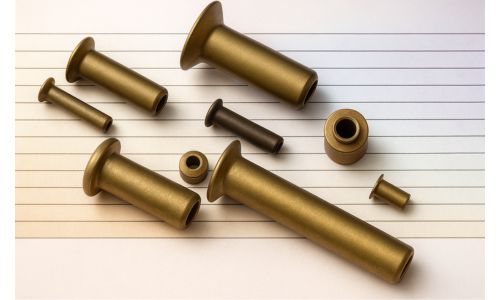
Materials and surface treatment
Aeronautical rivets are manufactured in materials that combine mechanical resistance, lightness and galvanic compatibility with the surfaces to be joined, thus avoiding corrosion by electrochemical contact. The most common materials include:
- Aluminum alloys (2000 and 7000 series): used for their good strength-to-weight ratio. The 2000 series offers high mechanical strength and is used in structural applications, while the 7000 series provides higher hardness and is ideal for extreme stress conditions.
- Titanium: excellent for high performance applications due to its high mechanical strength, corrosion resistance and low specific gravity. It is common in fighter aircraft and areas exposed to high temperatures.
- Stainless steel: preferred in applications where high resistance to wear and corrosive environments is required. It has good mechanical strength, although it is heavier.
- Superalloys such as monel: nickel-copper alloy with high corrosion resistance, especially in saline or chemical environments. Used in naval aircraft or components operating in hostile environments.
In addition, rivets can receive different surface treatments depending on the function and operating environment:
- Anodizing: improves corrosion resistance and increases surface hardness, very common in aluminum rivets.
- Passivation: chemical treatment for stainless steels that removes surface contaminants and strengthens their corrosion resistance.
- Anticorrosive coatings: such as cadmium plating, zinc plating or polymeric coatings, which act as a protective barrier against oxidation and friction.
These treatments not only extend the life of the rivet, but also ensure its functional compatibility with the rest of the aircraft’s structural components.
Manufacturing process for rivets used in the aerospace industry
The cold heading is a mechanical metal forming process is a process of mechanical forming of metals at room temperature using high tonnage presses and precision tooling. The material, usually in the form of wire or bar, is introduced into a die where it is shaped by successive tapping, without generating swarf.
This process offers multiple advantages for the manufacture of rivets:
- High dimensional accuracy, allowing tight tolerances ideal for sectors such as aeronautics.
- Excellent surface finish, reducing the need for subsequent machining.
- Improved mechanical properties due to strain hardening, which increases the ultimate strength of the rivet.
- Reduction of material waste, as no chips are generated, which optimizes production costs.
- Repeatability and consistency, ideal for large production runs.
At Estampaciones LEMEC, this process is complemented with:
- Uncolletting, to obtain smooth transitions and complex geometries.
- Threading, if hybrid screw-rivet type components are required.
- Dimensional controls and tests, integrated in line to ensure the quality of each manufactured batch.
Cold heading also allows a high adaptability to specific customer requirements, manufacturing customized rivets both in geometry and in material and treatment, complying with demanding international standards such as EN 9100:2018.
Criteria for choosing a supplier of rivets for the aerospace industry
Choosing the right supplier goes beyond price. Some key criteria include:
- Quality certifications: EN 9100:2018, ISO 9001
- Experience in the aeronautics and defense industry
- Ability to manufacture to drawing and sample
- In-house quality control laboratories (tensile tests, hardness tests, etc.)
- International logistics and delivery fulfillment
How to request a quotation for special rivets for the aerospace industry
When requesting a quote, be sure to include:
- Technical drawing with tolerances (MS/NAS detailed specifications)
- Desired material
- Estimated quantities and order frequency
- Final application (civilian, defense, temperature, cargo)
This detail allows Estampaciones LEMEC to offer an adjusted and competitive proposal.
Why choose Estampaciones LEMEC as a supplier for aeronautical rivets?
- Specialists in cold heading and decolletizing for critical parts
- EN 9100:2018 certification for the aeronautical sector .
- Domestic production with international logistics
- Rapid prototyping and industrial series capability
- Technical department that advises from the design phase onwards
Get in touch with us
Contact our technical office and tell us what kind of steel parts you need to manufacture.
We will study your case and propose a customized, fast and efficient cold stamping solution.