Aeronautical fasteners: A complete guide to selecting certified fasteners
In aerospace, aerospace fasteners are a critical component that ensures the structural integrity of aircraft. Its selection, manufacture and certification require very strict standards due to the extreme conditions to which aircraft are subjected. This guide addresses everything you need to know to understand its importance and choose the right supplier.
What is aircraft fasteners and why are they critical in aviation?
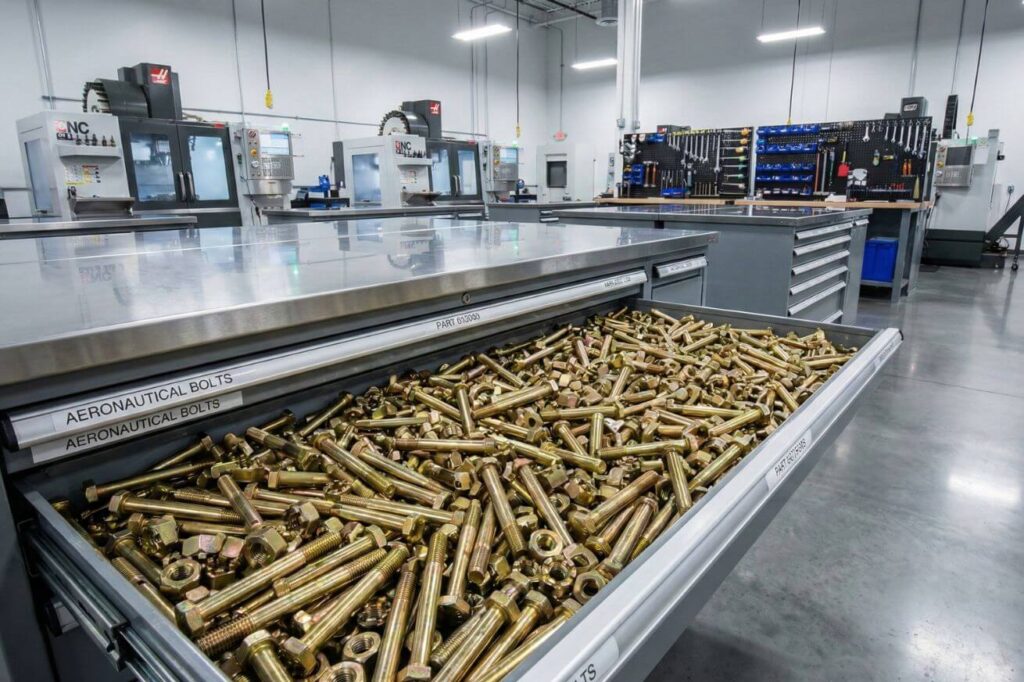
Aeronautical fasteners refer to all fasteners (screws, bolts, nuts, pins) used in aircraft construction and maintenance. Unlike conventional industrial fasteners, they must withstand vibrations, pressures, temperature changes and load cycles without failure.
Need help?
Contact our technical office and tell us about your project.
We will study your case and propose a solution to manufacture them.
Definition and differences with respect to standard fasteners
These fasteners are designed with special materials, heat treatments and specific manufacturing processes that improve their resistance to fatigue and corrosion. You cannot substitute an aircraft fastener for a commercial fastener without compromising safety.
| Feature | Standard fasteners | Aeronautical fasteners |
|---|---|---|
| Materials | Common steel, basic stainless steels | Specific alloys (8740 steel, titanium, etc.) |
| Heat treatment | Optional | Mandatory (quenching, tempering, etc.) |
| Manufacturing processes | Basic machining or stamping | High precision cold heading with high precision |
| Quality control | General, poorly documented | Rigorous, with traceability per batch |
| Regulations | Generic ISO | AN, NAS, MS, EN9100, NADCAP, among others. |
| Applications | General industrial use | Critical structures in aviation |
Importance for structural safety
Each bolt plays a key role in keeping the aircraft parts together: from the fuselage and wings to the landing gear components or engines. One failure could compromise the entire aircraft.
Types of fasteners used in aeronautics
Fasteners for the aeronautical sector include different types of fasteners, selected according to their application and mechanical requirements.
Screws and bolts (AN, MS, NAS)
- AN (Army/Navy): Classic standards used since the mid-20th century, especially in military and general aviation. These screws have a class 3 UNF thread and are easily identifiable by the markings on their heads. They are noted for their good availability, mechanical reliability and relative low cost.
- MS (Military Standard): Widely adopted in defense applications and later in civilian industry, MS fasteners offer a wider range of sizes, finishes and configurations, including nuts, washers and special screws. They ensure cross-platform interoperability.
- NAS (National Aerospace Standard): Designed for more demanding conditions, NAS bolts feature tighter tolerances and are manufactured from higher strength materials. They are commonly used in critical joints subject to vibration and cyclic loading, such as engine anchorages or airframe structures.
Nuts, washers, dowels and rivets
In aeronautics, not only screws and bolts are used, but also a variety of complementary elements essential to ensure robust mechanical joints:
- Self-locking nuts: Prevent loosening due to vibrations, very common in commercial and military aircraft.
- Lock washers and lock washers: distribute the load and reinforce the stability of the joint.
- Pins and cotter pins: Used in moving assemblies such as hinges and control surfaces.
- Structural rivets: Used where it is not possible to apply screws, they offer a permanent and resistant joint.
- Blind bolts and Hi-Lok systems: Ideal solution in enclosed structures where access is from one side only; they combine precision with ease of installation and are present in fuselage cladding, panels and hard-to-reach areas.
Typical applications by component
- Primary structures: steel bolts to join wings and fuselage.
- Engine areas: superalloys such as Inconel to resist high temperatures.
- Control surfaces: light and precise screws.
Materials and properties required in aeronautical fasteners
he choice of material impacts the weight, strength and durability of each screw.
Typical alloys
- Cadmium-alloyed steel (AISI 8740): High strength (~125,000 PSI).
- CRES stainless steel: Ideal against corrosion.
- Aluminum 2024-T4: Lightweight for non-critical components.
- Titanium Ti-6Al-4V: Superior strength-to-weight ratio.
- Superalloys (Inconel, A-286): For extreme temperatures.
Coatings and treatments
Anodizing, cadmium plating or zinc-nickel plating are common for corrosion protection. In addition, each screw receives heat and hardness treatments to meet required standards.
Key certification in aerospace fasteners: EN9100
Specific standard for the aerospace industry.
The EN9100 standard goes beyond ISO 9001, including key requirements such as:
- Full traceability of materials and processes.
- Rigorous control of documentation and changes.
- Validation of special processes.
- Continuous supplier evaluation.
- Risk management and continuous improvement.
EN9100 certification is a guarantee that the supplier complies with the highest standards required by the world’s leading aeronautical manufacturers. This certification positions LEMEC as a reliable technical partner for projects that demand quality, precision and regulatory compliance.

Manufacturing process: from raw material to certified screw
Modern aerospace fastener manufacturing employs two main technologies depending on the type of part: cold heading, ideal for high-volume standard fasteners, and bar turning, optimal for bolts and parts with complex geometry or more flexible productions.
Cold Heading (Cold Heading)
- Cutting of the wire into precise sections (slugs).
- Head forming by sequential strokes.
- Cold thread rolling, without removing material.
- Heat treatments (quenching, tempering).
- Surface coatings and marking.
- Quality control and inspections.
This process preserves the structure of the material, aligns the grain flow and improves fatigue resistance, being the most efficient and resistant method for large volumes.
Turning (CNC Automatic Lathe)
- Selection of metal bar according to specification.
- Multi-axis CNC lathe machining, capable of producing parts with complex geometries, grooves, chamfers or internal bores.
- Precise finishes and tight tolerances, ideal for special bolts or custom parts.
- Heat treatments and coatings, as in stamping.
- Final inspection and dimensional validation.
Bar turning allows flexibility in design and adaptation to specific technical requirements, being the preferred method when customization or low volume is required.
Choosing a reliable supplier: LEMEC as a strategic ally
Selecting a specialized supplier is crucial. LEMEC stands out for:
- Experience in metal cold heading and CNC bar turning.
- Compliance with ISO EN9100 certification.
- On-demand and customized production for the aeronautical sector.
LEMEC is positioned as a strategic partner for companies looking for high performance fasteners with guaranteed quality, safety and traceability.
Get in touch with us
Contact LEMEC today to find out how they can help you develop custom certified fasteners for your aerospace needs.