Stainless Steel Fasteners for the Marine Sector
It is a more common scenario than it may seem: a screw that begins to show rust just a few months after installation, a fastener that fails during a maintenance operation, or a stain that appears on deck after a seemingly correct refit. These failures are not coincidental. They are the result of a poor choice of material, process, or specification.
The key question is: what makes a fastener truly suitable for the sea?
Stainless steel fasteners for the marine sector are a technical solution designed to withstand extreme conditions, and understanding how they work is the difference between a long-lasting installation and a short-term problem.
Why the marine sector demands high-specification stainless steel fasteners
The marine sector is the most demanding for any metal fastener. metal fastening elements. The simultaneous combination of high salinity, constant humidity, cyclic mechanical loads and thermal changes creates conditions that accelerate all known metal degradation mechanisms.
Some of the most common issues include:
- Salt corrosion: salt acts as an accelerator of deterioration.
- Galvanic corrosion: occurs when two dissimilar metals come into contact.
- Mechanical fatigue: the constant motion of the sea generates microfractures.
- Galling: screws can seize up during assembly.
In simple terms, if you use the wrong fasteners, they may appear to work at first, but they will fail in a short time.
Need help?
Contact our technical office and tell us about your project.
We will study your case and propose a solution to manufacture them.
Materials for marine fasteners: how to choose the right one
Not all stainless steels offer the same level of resistance. Their protection against corrosion depends on their composition: chromium creates a passive layer that acts as a barrier, while molybdenum reinforces it against sea salt.
That is why choosing the right material is not just a matter of cost, but of preventing failures and corrosion over time.
A2 (AISI 304)
- Recommended use: dry interiors
- Advantage: more economical
- Disadvantage: low resistance to saltwater
A4 (AISI 316)
- Recommended use: outdoor and saltwater exposure
- Contains molybdenum, which acts as a shield against salt
- It is the standard for marine applications
A4-L (AISI 316L)
- Higher corrosion resistance
- Ideal for critical or welded areas
Quick comparison
| Material | Marine resistance | Typical use |
|---|---|---|
| A2 | Low | Interior |
| A4 | High | Deck, hull |
| A4-L | Very high | Critical applications |
A4 / AISI 316 fasteners are the minimum standard for any exterior-exposed fastening on a vessel. A2 is reserved exclusively for dry interiors.
How stainless steel fasteners for vessels are manufactured
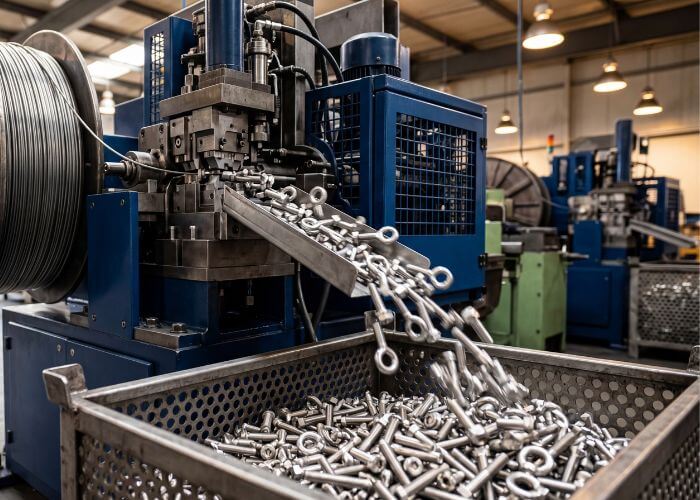
The quality of a screw depends not only on the material, but also on the manufacturing process. There are two main processes for manufacturing stainless steel fasteners: cold heading and CNC turning.
The choice between the two is not arbitrary, but a technical and economic decision that depends on the production volume, the geometric complexity of the part, and the required tolerances.
Cold heading
Cold heading is a forming process in which metal is shaped by applying pressure at room temperature.
Advanges:
- Higher mechanical strength
- Lower production cost
- Preserves the material structure
Basic process:
- Material cutting
- Cold forming
- Thread rolling
- Treatments and passivation
- Quality control
CNC turning
Used for special parts or manufacture to drawing.
Advanges:
- High precision
- Complex geometries
- Ideal for custom parts
Which one to choose?
- Mass production: cold heading
- Special parts: CNC turning
In many cases, both processes are combined to achieve the best result.
Types of screws used in the naval sector
Each type of screw serves a specific function on board. Beyond the shape, what matters is where it works and what stress it withstands.
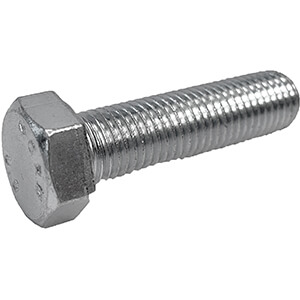
Hex head screw (DIN 933 / ISO 4014)
- Use: structural fastenings on deck and hull
- Feature: withstands high tightening torques
- Typical application: main joints in shipyards and metal structures
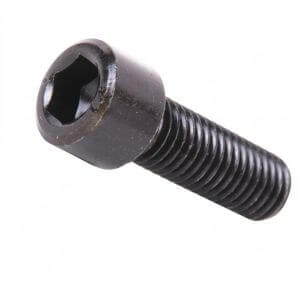
Socket head cap screw (DIN 912 / ISO 4762)
- Use: steering mechanisms, masts, and fittings
- Feature: allows working in confined spaces
- Typical application: areas with no lateral access for conventional tools
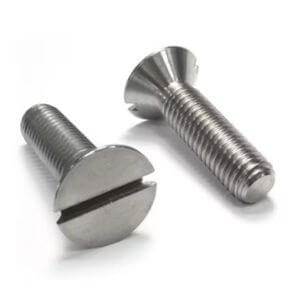
Countersunk screw (DIN 963 / 965)
- Use: flush-mounted installations
- Feature: the head sits level with the surface, preventing obstructions
- Typical application: decks, panels, visible finishes
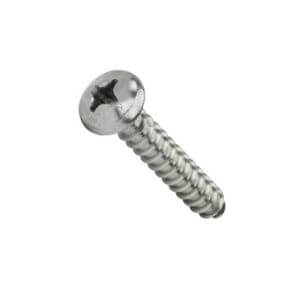
Self-tapping screw / sheet metal screw (DIN 7981 / ISO 7049)
- Use: soft materials such as fiberglass, aluminum, or wood
- Feature: creates its own thread
- Typical application: quick assemblies in interiors or non-structural elements
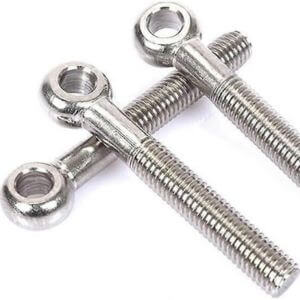
Eye bolts and lifting eyes (AISI 316)
- Use: anchoring systems, rigging, and maneuvering
- Feature: high-responsibility parts subjected to load
- Typical application: mooring, hoisting, and elements under tension
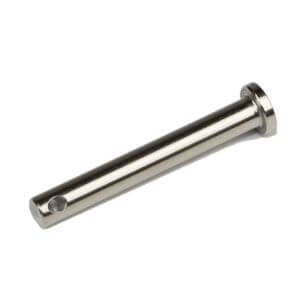
Clevis pins and dowel pins
- Use: critical articulations
- Feature: allow controlled movement with safety systems
- Typical application: rudder, hinges, moving mechanisms
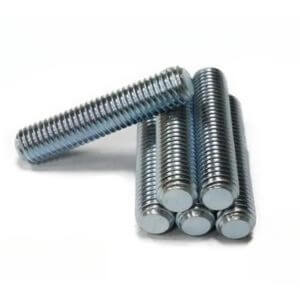
Threaded studs (DIN 976)
- Use: engine fastenings and internal structures
- Feature: threaded on both ends
- Typical application: engine mounting, mast guides
Standards for stainless steel fasteners in the marine sector
Standards ensure that fasteners meet minimum technical requirements.
The most important ones are:
- ISO 3506: mechanical properties of stainless steel
- DIN: geometry and manufacturing standards
- UNE-EN: European adaptation of international standards
Strength classes
- A4-70: standard use
- A4-80: higher strength
What you should require as a customer
- Material certificate
- Batch traceability
- Regulatory compliance
This ensures that the product is reliable and safe.
What to require from your marine fastener supplier
Choosing the right material is only half the decision. The other half is choosing who manufactures it. A screw specified in AISI 316 A4 can lose a significant part of its properties if the manufacturing process is inadequate, if there is no batch traceability, or if the manufacturer lacks the technical judgment to flag errors before production. Before confirming a supplier, verify that they meet these six criteria:
- Process suitable for AISI 316. They must work with cold forming to avoid sensitization of the steel and preserve the passive layer that ensures marine resistance.
- Manufacture-to-drawing capability. The marine sector frequently requires parts that do not exist in any catalog. A manufacturer must be able to produce exactly what the drawing specifies.
- Certifiable material traceability. The 3.1 certificate according to EN 10204 is the minimum standard required when a Merchant Marine inspection or classification society is involved.
- Technical advice on materials. A reliable supplier discusses with the customer which alloy is appropriate for each application, and also advises against over-specification when it is not justified.
- Volume flexibility without compromising quality. They must be able to deliver the same level of quality for a batch of fifty special parts as for a run of hundreds of thousands of standard screws.
- Proven experience in high-demand sectors. A track record in automotive, aerospace, or chemical industry is a transferable guarantee: these sectors share with the marine environment the same demands for traceability, tolerances, and extreme conditions.
At Lemec, these six criteria are covered by two manufacturing processes: cold heading and CNC turning. four simultaneous certifications, and over 60 years producing for the most demanding industrial sectors. If you have a marine project that requires stainless steel fasteners, Lemec’s engineering team studies each case from specification to delivery.
Do you have a marine project that requires stainless steel fasteners?
Get in touch with us
Contact our technical office and tell us what kind of steel parts you need to manufacture.
We will study your case and propose a customized, fast and efficient cold stamping solution.