Manufacturing of mechanical shafts for aerospace: cold heading, CNC turning, and CNC machining for the aerospace industry
At LEMEC, we manufacture custom metal shafts for the aerospace sector, specializing in auxiliary and support components where dimensional accuracy, batch repeatability, and traceability are decisive.
The manufacturing of shafts for the aerospace sector is one of the most demanding processes within aerospace engineering. These components are responsible for transmitting power, withstanding extreme dynamic loads, and maintaining the stability of critical systems in engines, landing gear, or flight control mechanisms.
The selection of the right process affects not only the performance of the component, but also production efficiency, fatigue life, and cost competitiveness.
Depending on the diameter, geometry, load level, and production volume, the optimal solution may vary between cold heading with CNC machining for larger critical components, or precision CNC turning for smaller-diameter shafts equally demanding in tolerances.
What are mechanical shafts in the aerospace sector?
Mechanical shafts in aerospace are mechanical elements designed to transmit torque, withstand rotational loads, and maintain the alignment of components within complex aeronautical systems.
Based on their function and criticality level, aircraft shafts are classified into two main groups:
Shafts for critical components:
This is where failure can compromise flight safety:
- Turbine engines
- Main transmission systems
- Flight control actuators
- Landing gear
- Engine auxiliary systems
Shafts for auxiliary and non-critical components:
These shafts are intended for support and comfort systems:
- Hinge mechanisms in cabin doors and hatches
- Compartment opening and closing systems
- Seat and cabin furniture mechanisms
- Wheels and ground support equipment (GSE)
Auxiliary components, although less demanding in load than critical ones, equally require high dimensional accuracy, full traceability, and EN 9100 certification. It is precisely in this segment where LEMEC specializes, offering custom metal shafts through cold heading and precision CNC turning for medium and high production runs within the aerospace sector.
Need help?
Contact our technical office and tell us about your project.
We will study your case and propose a solution to manufacture them.
Materials for manufacturing aerospace shafts
Material selection is the first critical decision in the manufacturing of an aerospace shaft, as it directly determines the manufacturing process, in-service behavior, and component service life.
Titanium Ti-6Al-4V
The most widely used option when weight is a critical variable. Its excellent strength-to-weight ratio makes it ideal for compressor shafts, actuators, and transmission systems. It responds very well to cold heading and CNC machining, although it requires specific tooling and cutting parameters due to its low thermal conductivity.
Inconel 718
A nickel-based superalloy reserved for areas subjected to high temperatures, especially shafts in turbine stages. Its creep resistance at high temperatures is irreplaceable in these environments, although its machinability is more demanding and generally requires isothermal forging as a preforming process.
300M Steel and 4340 Steel
High-strength aerospace steels are the dominant choice for landing gear shafts and high-load transmissions. They offer high toughness, excellent fatigue behavior, and are highly compatible with both cold heading and precision CNC turning for simpler geometries.
Manufacturing process for mechanical shafts in aviation
The manufacturing process for aviation shafts is defined according to the shaft diameter, the loads it must withstand, the production volume, and the required tolerances. In the aerospace industry, three main methods are used: cold heading, precision CNC turning, and CNC machining, each with a specific role within the production process.
The main processes used include:
Cold heading for aviation shafts
Cold heading is especially efficient when shafts feature changes in cross-section or larger diameters. Through plastic deformation of the material, a preform close to the final geometry is obtained, with key metallurgical advantages such as grain flow orientation, higher fatigue resistance, and lower material waste. For this reason, it is common in the batch production of structurally demanding shafts.
Precision CNC turning for smaller-diameter shafts
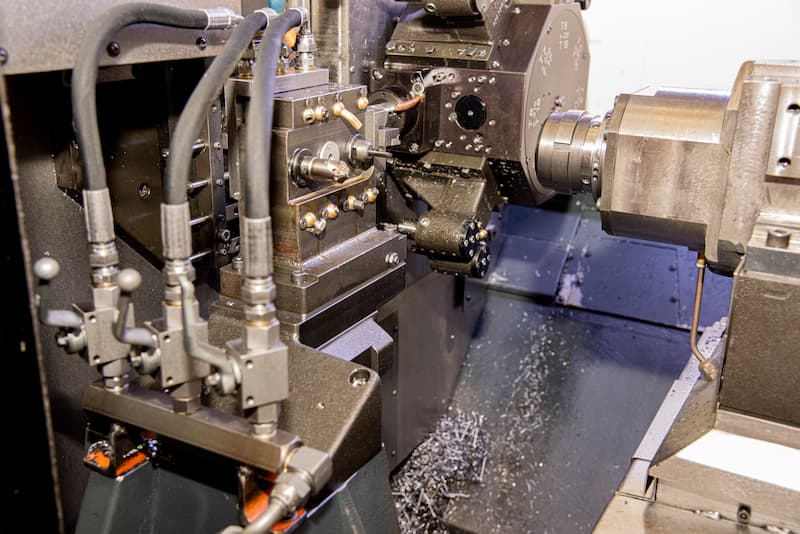
Precision CNC turning is the most competitive solution for smaller-diameter shafts with a defined geometry. By machining directly from bar stock using CNC automatic lathes, very tight tolerances are achieved with high repeatability and optimized costs for medium and high production runs. It is frequently used in actuators, auxiliary systems, and transmission mechanisms.
High-precision CNC machining
Aerospace CNC machining serves as the final finishing stage in both manufacturing routes. Operations such as precision turning, milling, deep drilling, or grinding allow tolerances of ±0.005 mm and surface finishes of Ra ≤ 0.4 μm to be achieved in critical areas.
Process combination: how to optimize the manufacturing of each aerospace shaft
In many aerospace programs, these technologies are combined to leverage the advantages of each. The cold heading + CNC machining route is optimal for larger shafts or high-load applications, while CNC turning + CNC machining offers maximum efficiency for smaller-diameter shafts produced in series.
| Manufacturing method | Typical shaft diameter | Main advantage | Typical applications |
|---|---|---|---|
| Cold heading + CNC | Medium / large | Metallurgical improvement (grain flow) and high fatigue resistance | Structural shafts, landing gear, load-bearing components |
| Precision CNC turning + CNC | Small / medium | High repeatability and optimized cost in series | Actuators, transmission mechanisms, auxiliary systems |
| CNC machining from bar stock | Variable | Flexibility for prototypes or short runs | Development, special parts, small batches |
Metal shafts for non-critical aerospace applications: LEMEC’s specialty
Our cold heading and precision CNC turning processes, backed by EN 9100 certification, allow us to supply shafts for applications such as:
- Hinge mechanisms in panels, cabin doors, and hatches
- Compartment opening and closing systems
- Seat and cabin furniture mechanisms
- Wheels and ground support equipment (GSE)
- Auxiliary systems and secondary transmission mechanisms
For these applications, we offer shafts in carbon steel, stainless steel, and aluminum, with surface treatments tailored to the requirements of each environment, and production runs ranging from a few thousand parts to several million.
If your project requires metal shafts for non-critical components within the aerospace sector, contact our technical team and we will study your case.
Standards and certifications in the manufacturing of components for the aerospace industry
The aerospace industry demands extremely rigorous standards to ensure the safety and reliability of components.
EN 9100 Certification
EN 9100 certification establishes specific requirements for quality management systems in the aerospace sector.
Special processes and Nadcap audits
Processes such as heat treatments or non-destructive testing often require Nadcap accreditation to ensure their technical conformity.
Non-destructive testing
To guarantee the integrity of the component, the following techniques are used:
- Ultrasonic testing
- Magnetic particle inspection
- Liquid penetrant inspection
- Industrial computed tomography
How to choose a supplier of mechanical components for aerospace
Selecting an EN 9100-certified aerospace component supplier requires evaluating multiple technical and industrial factors:
- Quality certifications
- Experience in the aerospace sector
- Batch production capability
- Integration of processes such as cold heading and CNC machining
- Traceability and document control systems
A supplier capable of integrating several manufacturing technologies offers greater efficiency, shorter lead times, and better process control.
Precision engineering for the manufacturing of aerospace shafts
The aerospace industry demands levels of precision and reliability that can only be achieved through the integration of advanced engineering, process control, and high-precision manufacturing technologies.
The combination of metal stamping and CNC machining makes it possible to produce aerospace shafts with excellent structural integrity, high repeatability, and significant cost optimization in batch production.
Specialized suppliers such as LEMEC, capable of integrating cold heading, precision CNC turning, and CNC machining under a single quality system, can guarantee the selection of the most efficient process for each shaft and offer greater traceability control, industrial competitiveness, and reliability in aerospace applications.
Get in touch with us
Contact our technical office and tell us what kind of steel parts you need to manufacture.
We will study your case and propose a customized, fast and efficient cold stamping solution.