Concrete screws: how they are manufactured and why they are critical in construction
Every structure that stands firm holds a secret few stop to notice: the quality of its fasteners. Concrete screws are those invisible components that bear loads, resist vibration and ensure an installation remains stable for decades. Yet not all are manufactured alike, and the difference between a generic screw and one designed to industrial precision standards can be the line that separates a reliable structure from a mid-term structural problem.
If you work in the construction sector and need to understand what lies behind these components (from their manufacturing process to the materials that determine their performance) this article will give you a perspective you will not find in a conventional catalogue.
What are concrete screws and how do they work
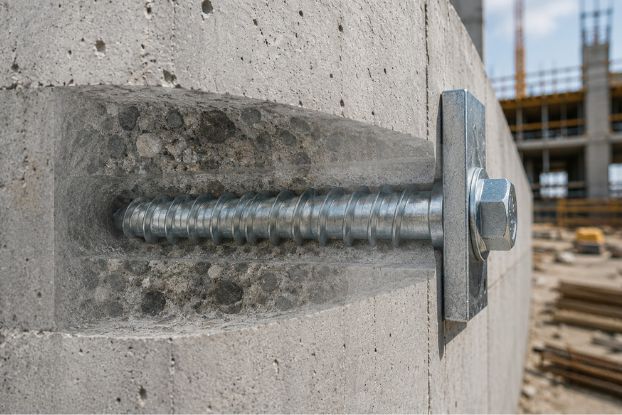
Concrete anchor screws are mechanical fastening systems designed to anchor directly into concrete, block or masonry surfaces. Their operation is based on a simple but effective principle: a hole is drilled with a carbide-tipped bit of the specified diameter, the screw is inserted and it cuts its own thread into the base material as it is driven in.
Unlike traditional systems that rely on plastic or metal plugs, these screws generate a direct mechanical fixing with high tensile and shear resistance. They also allow disassembly and reuse of the anchor point, making them a versatile solution for both new construction and refurbishment and technical installations.
Concrete screw manufacturing: from raw steel to finished part
This is where the real difference lies between a screw that performs and one that endures. The manufacture of concrete screws involves industrial processes that directly determine the mechanical properties of the finished product.
Cold heading
This process is the most widely used for long production runs. It involves forming the steel at room temperature using high-precision dies and punches, without material removal. The primary advantage is that the material undergoes work hardening that naturally increases its mechanical strength. This means stronger screws, with less material waste and competitive costs for high volumes.
Companies such as Lemec, a screw manufacturer in Spain with over 40 years of experience, use this process to produce industrial fasteners that meet the most demanding tolerances in the sector.
Precision CNC turning
For medium runs or special concrete screws with complex geometries, CNC turning offers a level of precision that stamping does not always achieve. Using numerically controlled lathes, parts are machined to tight tolerances, controlled surface finishes and specific technical requirements. It is the ideal process when a construction project demands custom solutions not available in standard catalogues.
Need help?
Contact our technical office and tell us about your project.
We will study your case and propose a solution to manufacture them.
Materials and coatings: the science behind strength
Choosing the right material is not a minor decision. Concrete screws are typically manufactured in high-strength carbon steel, but the choice of coating is equally critical.
Stainless steel, although popular, is not always the best option. In contact with aluminium or carbon steel in the presence of moisture, it can act as a cathode and accelerate corrosion of the other metal through galvanic action. For this reason, in many construction applications, carbon steel with a flake zinc coating proves more effective: it protects against corrosion without generating material incompatibilities.
Thread geometry also directly influences performance. Screws with trilobular thread forming cut the thread by plastic deformation of the concrete, without removing material or damaging the protective layers of the hole. This preserves the integrity of the anchor and minimises the risk of long-term failure.
Plug-free concrete screws: advantages in modern construction
Plug-free concrete screws represent the natural evolution of direct fastening systems. They eliminate the intermediate step of the plug, delivering concrete advantages for professional construction fasteners:
- Installation time reduction of between 30% and 50% compared to plug-based systems.
- Fewer components on site, simplifying logistics and reducing errors.
- Full disassembly without leaving metallic residues or chemical resins, in line with circular economy principles.
- Suitable for both cracked and non-cracked concrete, offering versatility across different structural scenarios.
This technology is particularly relevant in environments where the reversibility of the installation has technical and environmental value.
Applications in the construction sector
The versatility of these fastening systems makes them present in virtually every phase of a construction project:
- Anchoring of metal structures, frames and profiles.
- Fixing of electrical, HVAC and plumbing installations.
- Installation of metal joinery, railings and enclosures.
- Support of ETICS systems for external thermal insulation.
- Fixing of industrial equipment, signage and street furniture.
In all these cases, the quality of the screw (determined by its manufacturing process, material and coating) makes the difference between a fixing that lasts and one that compromises safety.
Choosing the right screw means designing for longevity
The selection of concrete screws should not come down to browsing a catalogue and choosing by price. Behind every part lie engineering decisions that affect the strength, durability and safety of an entire installation. Understanding how they are manufactured, what materials are involved and why one coating is more suitable than another is what separates a professional who fastens from one who builds to last.
Get in touch with us
Contact our technical office and tell us what kind of steel parts you need to manufacture.
We will study your case and propose a customized, fast and efficient cold stamping solution.