Metal parts manufacturing for agricultural machinery
Metal parts manufacturing for agricultural machinery is a critical link that determines the reliability of tractors, harvesters, seeders and all types of implements. Choosing the right process, material and supplier makes the difference between a machine that operates without interruption and one that generates unplanned downtime at the worst possible moment.
Why the agricultural sector demands high-specification parts
The agricultural industry operates under conditions few other industries can match. Abrasive soil in direct contact with components, constant moisture, exposure to corrosive fertilisers and agrochemicals, intense vibration and repeated impact loads campaign after campaign.
Added to this is a factor that compounds the pressure on every component: seasonality. At the height of sowing or harvesting, the machine cannot stop. There is no margin for improvising spare parts or tolerating fasteners that fail ahead of time. Every metal part must be designed and manufactured to withstand the complete cycle without compromising the operation.
Need help?
Contact our technical office and tell us about your project.
We will study your case and propose a solution to manufacture them.
Key metal parts in agricultural machinery and equipment
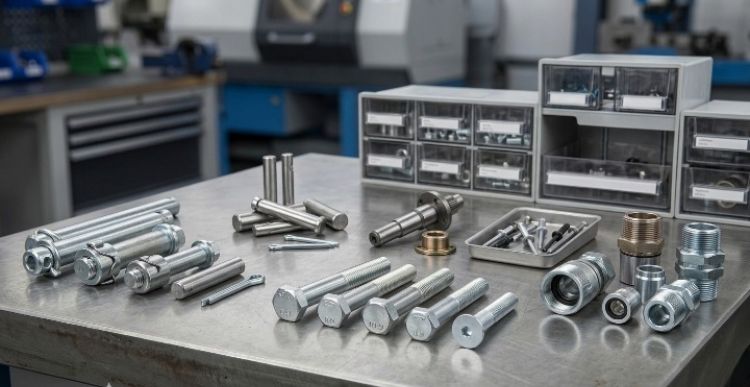
The range of metal components for harvesters, tractors and implements is broad, but certain part families account for the highest demand:
- Hitch bolts and pins: the backbone of the three-point linkage system connecting the tractor to its implements. They must withstand high tensile and shear loads, as well as thousands of coupling and uncoupling cycles.
- Pins and keys: present in articulations of cultivators, harrows and hydraulic arms, they function as pivot points under constant shear stress and severe vibration.
- High-strength bolts: secure plough blades, harrow discs and chassis structural elements. Grade 8.8 and 10.9 fasteners with rolled threads are the most in demand for their fatigue resistance.
- Shafts and bushings: used in transmissions, pulleys and depth adjusters, where dimensional precision and wear resistance are decisive.
- Rivets: used in hoppers, protective guards and lightweight structures where welding is not the most suitable joining method.
- Hydraulic terminals and connectors: fittings, ferrules and bushings that guarantee the sealing integrity of hydraulic circuits in tractors and harvesters.
Materials and surface treatments adapted to field conditions
Steel selection is not a minor detail: it conditions both manufacturability and in-service performance. SAE 1035 to 1045 carbon steels are the most common in tractor bolts and high-strength fasteners. For structures requiring lower weight without sacrificing load capacity, high yield strength steels are the standard choice.
The most widely used surface treatments include hot-dip galvanising, electrolytic zinc plating with passivation and zinc-nickel coatings for areas in direct contact with fertilisers and agrochemicals.
Cold stamping and CNC turning: how these parts are manufactured
For high-volume production of fasteners for agricultural machinery, cold stamping is the most efficient process. It allows thousands of parts to be manufactured per minute with material utilisation close to 100%, producing components with greater strength than machined parts thanks to work hardening and uninterrupted metal grain flow.
When the geometry is more complex or batch sizes are small, CNC turning provides the flexibility needed to manufacture special parts to drawing. Both processes complement each other to cover the full spectrum of sector requirements.
What an agricultural machinery manufacturer should demand from its parts supplier
Beyond material and process, there are criteria that separate a reliable supplier from one that generates problems:
- Capacity to absorb seasonal demand peaks without compromising lead times or quality.
- Full traceability material and production batch
- Recognised certifications backing the quality management system (ISO 9001, IATF 16949, ISO 14001).
- Technical advisory support for selecting the right alloy and process for each application.
- Volume flexibility: the same standard of excellence for a special parts batch as for a run of millions of units.
At LEMEC we have been manufacturing serial metal parts for the most demanding industrial sectors for over 60 years. Our and CNC turning capabilities, combined with four simultaneous certifications and a dedicated engineering team, allow us to offer complete solutions for metal parts manufacturing for agricultural machinery, from specification through to delivery.
Do you have a project in the agricultural sector?
Get in touch with us
Contact our technical office and tell us what kind of steel parts you need to manufacture.
We will study your case and propose a customized, fast and efficient cold stamping solution.