What does mass production of metal parts consist of?
The mass production of metal parts is an essential industrial process for many companies that require uniform, precise and high-quality metal products. Thanks to techniques such as cold heading, it is now possible to produce large quantities of parts with impressive efficiency and reliability. Throughout this article we will explain in detail what this process consists of, how it works, what advantages it offers and why rely on specialists like LEMEC.
What does mass production of metal parts mean?
When we talk about mass production, we are referring to the mass production of metal components in a standardized way. This methodology is based on the continuous repetition of the same process to obtain thousands (or millions) of identical units, maintaining uniform quality and reducing costs per unit.
Definition and general concept
The mass production of metal parts is common in sectors such as automotive, electronics, construction and household appliances. It relies on automated production lines, high-precision machinery and tools such as dies or dies that allow the metal to be worked efficiently.
Key factors: quantity, cost, lead time, uniformity, repeatability
The advantages of this approach lie in its scalability: the higher the volume, the lower the unit cost. In addition, repeatability is ensured (all parts are the same), human error is reduced and production speed is improved.
Need help?
Contact our technical office and tell us about your project.
We will study your case and propose a solution.
Common techniques for mass production of metal parts
There are several techniques for mass producing metal parts, and the choice of one or the other depends on the type of part, the material, the geometry and the volume required. Among the most widespread are stamping and bar turning, both of which are very efficient for obtaining large quantities with high precision.
Serial metal stamping
It is a technique that consists of applying pressure to a metal bar by means of a die to give it shape. It can be done cold or hot.
Difference between cold heading and hot stamping
Cold heading is carried out at room temperature, which preserves the properties of the metal and allows high-quality finishes to be obtained with very tight tolerances. Hot stamping, on the other hand, makes it easier to work with harder metals or complex geometries, although with less dimensional precision.
When each technique is appropriate
If large volumes, speed, energy savings and excellent surface quality are required, cold heading is the most suitable option. For very large parts or alloys that are difficult to form, hot or semi-hot stamping is used.
Series production by bar turning
Bar turning, also known as machining on automatic and CNC lathes, is ideal for small to medium-sized parts, usually cylindrical, that require extremely high precision, threads, bores or geometries that stamping cannot achieve.
Its main advantage is flexibility: it allows manufacturing long or short series with fast production changeovers and excellent dimensional quality.
How metal parts are manufactured in series by cold heading
The production of metal parts in series by cold heading is a technique that allows metal forming without applying heat, using only mechanical or hydraulic pressure on the material.
Step by step process
- It starts from bars or wires.
- The material is fed into a press equipped with a specific die.
- Pressure is applied to deform the metal to the desired shape.
- The part is removed, inspected and passed to possible finishing or threading processes.
Phase 1: Preparation of the material
The material must be clean, free of oxides and cut to the proper length (blanks). Lubricants can also be applied at this stage to facilitate the process and reduce die wear.
Phase 2: Positioning and fastening
The cut material is placed on the die. A clamping system (clamps) ensures that there is no displacement during stamping.
Phase 3: Forming
The buterola presses the material against the die. This step can include various shapes, depending on the desired final geometry.
Phase 4: Extraction and control
Once formed, the part is ejected by mechanical systems. Its shape, dimensions and surface finish are inspected before proceeding to subsequent treatments.
Machinery and dies
Mechanical, hydraulic or progressive presses are used. Dies are custom-made according to the part design, and must be extremely strong to withstand thousands of cycles without deformation.
Types of presses used
- Mechanical presses: fast and precise, ideal for high production rates.
- Hydraulic presses: apply more force, suitable for deep drawing or hard materials.
- Progressive or multi-stage presses: allow multiple operations on a single line, optimizing cycle time.
Die design
The die design is critical. It is made using CAD/CAM software and is constructed of heat-treated steel to withstand the extreme loads of the process.
Types of parts that can be manufactured by cold heading of serial metal parts
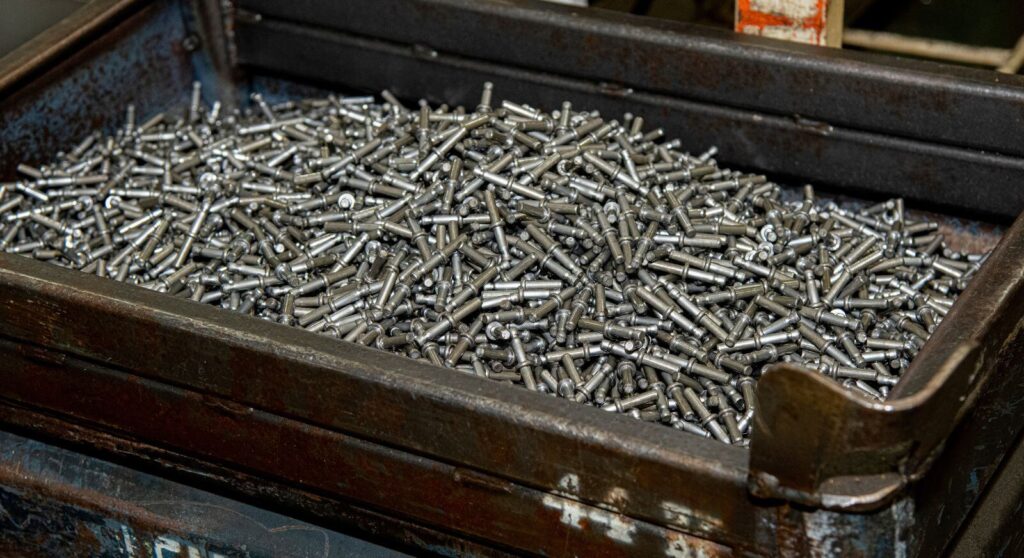
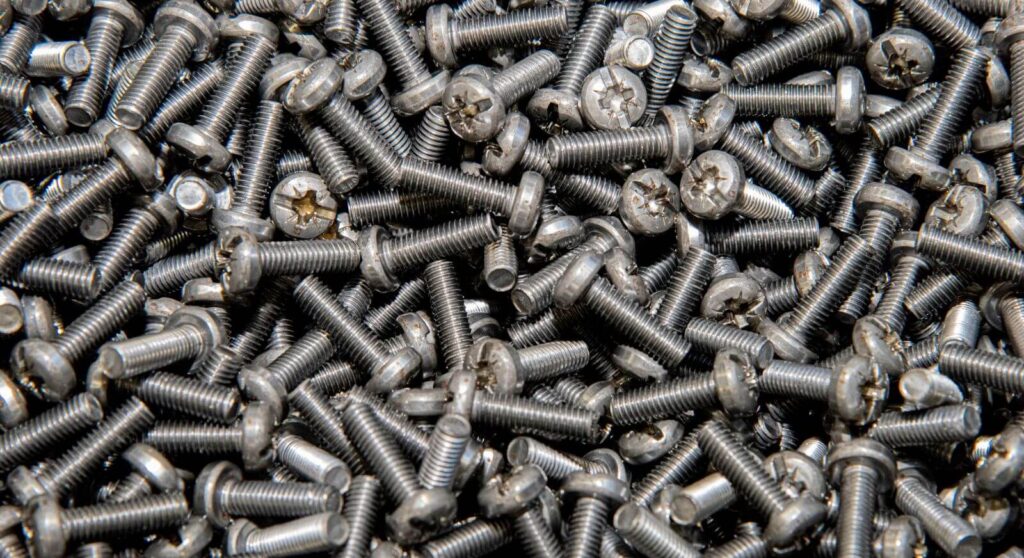
Among the parts manufactured in series by cold heading are: screws, nuts, electrical connectors, structural supports, metal housings, hinges, among many others. It is also possible to produce decorative or precision elements for sectors such as automotive, electronics or household appliances.
Advantages and limitations of the cold heading method
This process has numerous benefits, although it also has certain technical limits that are important to know in order to evaluate its viability in each case.
Key benefits
- High dimensional accuracy and fine finishes.
- Increased hardness due to cold deformation (hardening of the material).
- Very high production speed.
- Low energy consumption as no heat is required.
- Ideal for large volumes of metal parts in series.
Technical and economic limitations
- Requires initial investment in dies and machinery.
- Not all complex geometries can be realized in a single step.
- Less flexibility for frequent design changes.
When is it advisable to opt for mass production?
Choosing mass production makes sense when you are looking for low unit costs, fast delivery times and absolute uniformity in the final product.
Key indicators
- High volume of parts required.
- Definitive and stable design.
- Tight deadlines and the need for reliability.
Advice for SMEs and new projects
Small and medium-sized companies can benefit from this model by outsourcing production to suppliers such as LEMEC, which already have the necessary infrastructure and can manufacture even medium runs efficiently.
How to choose a specialized supplier for the mass production of metal parts
Selecting a reliable supplier is key to ensure quality, on-time delivery and cost optimization.
What to consider
- Demonstrable experience in metal stamping.
- Technical capacity and available machinery.
- Compliance with quality standards.
- Personalized advice and die design.
Why trust LEMEC?
LEMEC is a company specialized in the manufacture of metal parts in series by cold heading in Spain. With an extensive track record, it offers customized solutions for demanding industrial sectors.
Services, experience and advantages
- Development and design of customized dies.
- Automated production with state-of-the-art presses.
- Wide range of typical parts and possibility of new developments.
- Advice from design to final finishing.

Contact or next steps
Get in touch with us
Contact our technical office and tell us what kind of steel parts you need to manufacture.
We will study your case and propose a customized, fast and efficient cold stamping solution.