Allen screws: Types, uses and where they are manufactured
Have you ever tried to tighten a screw with the wrong screwdriver and ended up stripping the head? If you work in machinery, automotive, electronics, or advanced DIY, you know exactly what we mean. Allen screws exist precisely to eliminate that problem: they offer precise fastening, support high torque, and work in spaces where no other screw can fit.
In this guide you will find everything you need to know: what they are, what types exist, which sectors they are used in, and why to choose them over classic slotted or Phillips screws. And if you decide to buy, at LEMEC we have the catalog your project needs.
What is an Allen screw and how does It work?
An Allen screw, technically known as an internal hex screw or socket head cap screw, is a fastening element whose head incorporates a six-sided cavity on the inside. This geometry allows the Allen key to fit completely inside the screw, transmitting force in a distributed and secure manner.
Hexagonal geometry: The key to its superiority
Unlike slotted or Phillips screws, where the tool contacts the surface tangentially, the Allen key wraps around all six sides of the internal cavity. This means force is distributed evenly, the risk of slipping is minimized, and the screw head withstands much more torque without deteriorating.
- Higher torque: The hexagonal geometry allows reaching torsion values that other profiles cannot sustain.
- No lateral slipping: The key is retained inside the hexagon, making the slippage that ruins other heads impossible.
- Low, compact profile: The head does not protrude excessively, allowing use in very tight spaces.
- Clean appearance: Ideal for visible assemblies where aesthetics also matter.
Types of Allen screws by head
Not all Allen screws are the same. The variety of available heads allows this type of fastener to be adapted to virtually any technical or aesthetic need. Knowing the types of Allen screws is essential for choosing the right one for each project.
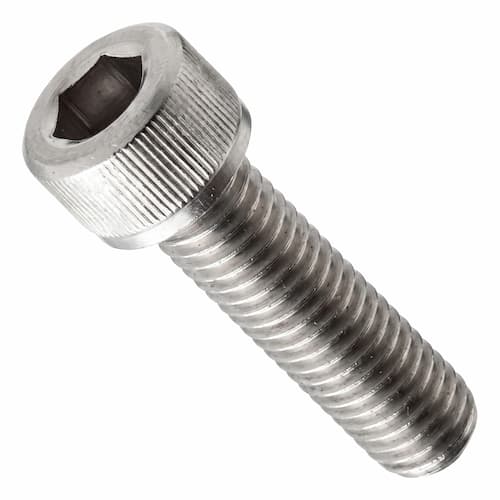
Cylindrical Head (Socket)
This is the most widely used model. Its cylindrical head, slightly wider than the shank, provides a very firm fastening. Standardized under DIN 912 and ISO 4762, it is the preferred choice in industrial machinery, robotics, and metal structures where high mechanical resistance is required.
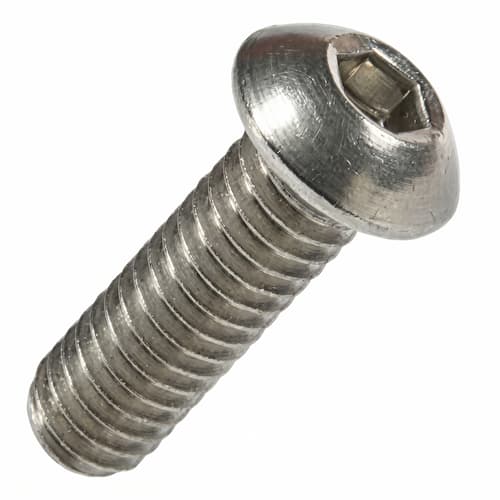
Button Head
With a rounded, low profile, this variant eliminates sharp edges. It is recommended in areas with pedestrian traffic, conveyor belts, or any application where a protrusion could pose a snagging or injury hazard.
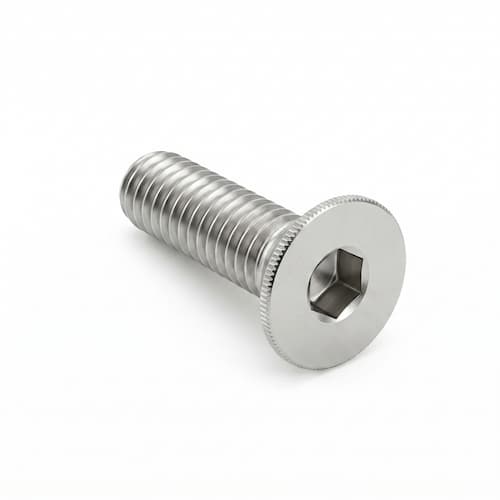
Flat or Countersunk Head
Designed to sit completely flush with the surface once installed. It is the perfect choice for electronic equipment, medical devices, metal carpentry, and any application where a smooth profile is essential. Standardized under ISO 10642 and DIN 7991.
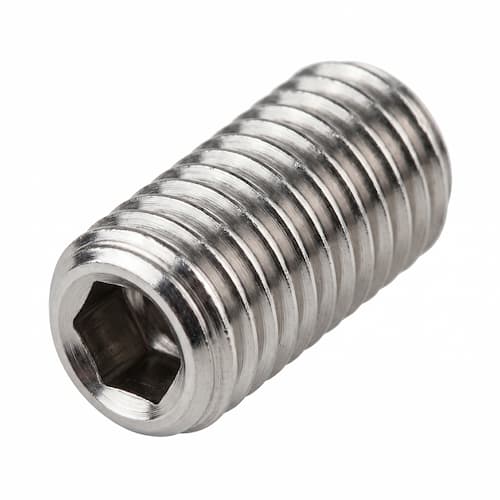
Set Screw (Headless)
A fully threaded rod with the internal hex at one end. It is used to secure internal parts against a shaft, such as pulleys, gears, or couplings. Very common in the food industry and in high-temperature applications.
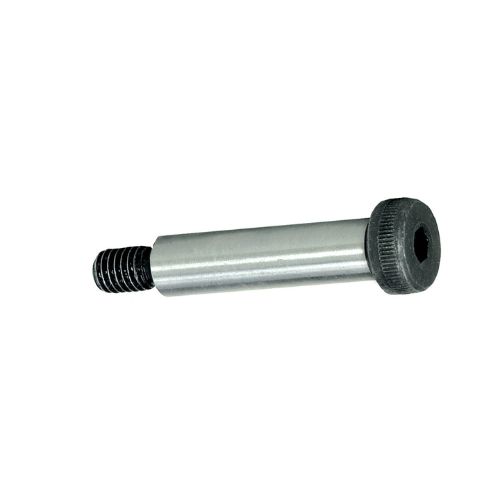
Shoulder Screw
Features a smooth, precision-ground section between the head and the thread. This section allows rotational or sliding movement of another part, functioning as a precision shaft or pin. Used in linear guides, actuators, and positioning systems.
Need help?
Contact our technical office and tell us about your project.
We will study your case and propose a solution to manufacture them.
Uses of Allen Screws: Where Are They Applied?
The versatility of Allen screw applications is one of their greatest strengths. From a bicycle to an aircraft, including the furniture in your living room, this type of fastener is present in virtually every industrial and domestic sector.
Industry and machinery
In industrial environments, Allen screws are essential for assembling equipment subjected to high loads and constant vibrations. Their high resistance makes them suitable for presses, lathes, industrial robots, and automated production lines.
Automotive and Motorcycling
In the automotive and motorcycle sector, these screws are used in critical components: engines, brake systems, suspensions, and fairings. Their ability to work in tight spaces and withstand engine vibrations makes them the fastener of choice for professional mechanics.
Electronics and Robotics
The compact size of the smaller variants (M2, M3, M4) makes them indispensable for assembling circuit boards, device housings, and robotic arms. In robotics, they also allow millimeter-precision adjustments.
Furniture and Construction
Major consumer furniture brands use this type of screw in their assembly kits, precisely because they facilitate assembly without bulky tools. In metal construction, they are used in structures, anchors, and joints that must withstand high static loads.
Why Choose an Allen screw over a Phillips or slotted one?
This is one of the most frequently asked questions among professionals and hobbyists. The answer has a technical basis, but also a practical one: the Allen screw simply works better in most demanding scenarios. Here is the comparison:
| Feature | Slotted | Phillips (Star) | Allen (Hex) |
| Tool grip | ❌ Slips | ⚠️ Irregular | ✅ Full |
| Torque capacity | ❌ Low | ⚠️ Medium | ✅ High |
| Risk of cam-out | ❌ High | ⚠️ Moderate | ✅ Minimal |
| Use in tight spaces | ❌ Difficult | ❌ Difficult | ✅ Ideal |
| Head durability | ❌ Low | ⚠️ Medium | ✅ High |
The slotted screw was designed for slow manual tools and low-demand work. The Phillips screw, although an improvement, was deliberately designed to cam out when a certain torque was reached — which is now a disadvantage in precision applications. The Allen screw, on the other hand, maintains full contact until the end of tightening, with complete control over the applied force.
Manufacturing Allen Screws: Cold Forming vs. Machining
Understanding the manufacturing process of Allen screws helps explain why there are such large quality differences in the market. The two main methods are cold forming and traditional machining, and their results are very different.
| Feature | Cold Forming | Traditional Machining |
| Material waste | 1-3% | Up to 75% |
| Production speed | Up to 600 pcs/min | Slow cycles |
| Mechanical resistance | High (work hardening) | Requires extra treatment |
| Surface finish | Very smooth and uniform | Tool marks |
Cold forming (also called cold heading) consists of deforming steel at room temperature using high-precision dies. This process not only minimizes material waste, but also produces work hardening that improves the screw’s resistance without the need for additional heat treatment. Furthermore, by preserving the steel’s grain flow, the part becomes tougher against dynamic loads and vibrations.
Machining, while useful for special parts or low volumes, generates up to 75% residual material and cuts the grain structure, weakening the part. For this reason, quality Allen screws are always produced by cold forming.
The Right Screw Makes the Difference: Trust LEMEC
A well-executed project starts with choosing the right component. Allen screws are not just another fastener: they are the difference between a joint that holds up for years of work and one that fails at the worst moment. Knowing their types, uses, and manufacturing process allows you to make more informed and safer decisions.
At LEMEC we have a complete catalog of Allen screws in different materials, finishes, and metric and imperial sizes, so you can find exactly what your application needs. If you have questions about which screw is most suitable for your project, our technical team is at your disposal. We don’t just sell screws — we guarantee the fastening your work deserves.
Get in touch with us
Contact our technical office and tell us what kind of steel parts you need to manufacture.
We will study your case and propose a customized, fast and efficient cold stamping solution.