Bolt manufacturing: types, materials and industrial process
Most failures in fastening systems do not occur at the moment of installation. They occur because a screw was used where a bolt was required, because the material was not suited to the environment, or because bolt manufacturing did not meet the tolerances the application demanded.
This article covers what a bolt is, how it differs from a screw, what types exist, and how they are manufactured for industrial applications where the margin for error is zero.
What is a bolt?
A bolt is a metal fastening element consisting of a cylindrical shank with a head at one end and a thread at the other, designed to work together with a nut. It does not anchor into the base material: it passes through it and is tightened from both sides, allowing it to withstand high structural loads and resist tensile forces, shear, and vibration in high-demand industrial applications.
When to choose a bolt and when to choose a screw?
Bolts and screws are distinct fastening elements with specific functions. Choosing one over the other does not depend on the designer’s preference but on the actual conditions of the application: the type of load, the need for disassembly, the material of the parts being joined, and the demands of the assembly where they will be used. Using the wrong element does not only compromise the joint, it can invalidate the entire design.
| Criterion | Bolt | Screw |
|---|---|---|
| Fixing mechanism | Passes through the pieces, tightened with a nut | Anchored by threading directly into the material |
| Load type | Tension, shear, intense vibration | Moderate axial load |
| Disassembly | Frequent, without damaging the pieces | Limited, may deteriorate the thread in the material |
| Required access | Both sides of the joint | One side only |
| Typical application | Structures, heavy machinery, automotive | Light assemblies, electronics, carpentry |
When a joint must withstand high loads, allow repeated disassembly or guarantee structural integrity under continuous vibration conditions, the bolt is the right choice. The screw works well for simpler joints where access from both sides is not possible or the load does not justify a more robust solution.
Types of bolts we manufacture at LEMEC
There is no universal bolt. Each industrial application defines the geometry, material and tolerances of the component. At LEMEC we manufacture to drawing, which means the starting point is always the customer’s specification, not a standard catalogue.
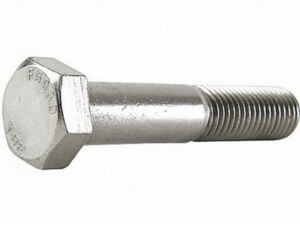
Hex head bolts
The most widely used type in industrial applications. The head allows torque to be applied with standard tooling and withstands high structural loads. Manufactured in multiple alloys depending on the working environment.
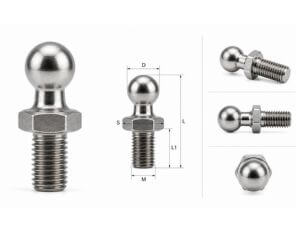
Ball bolts
Designed for articulated joints where angular movement must be absorbed without compromising the integrity of the fixing. Common in suspension systems, opening mechanisms and assemblies with controlled misalignment.
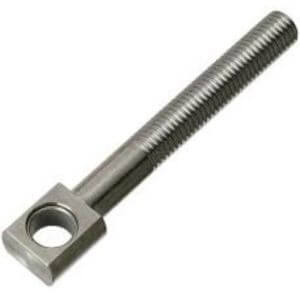
Bolts for hinges and opening systems
With specific geometries for mounting on industrial hinges, machinery doors and equipment access panels. Tight tolerances are required to guarantee correct rotation and durability of the assembly.
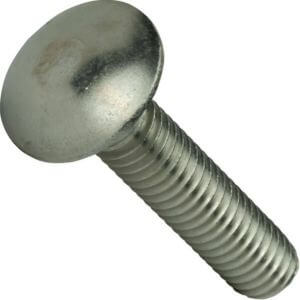
Body bolts
Used in automotive structures where vibration resistance and dimensional repeatability are decisive. Manufactured in long runs by cold stamping.
Through bolts
No differentiated head, threaded at both ends. Common in industrial machinery and metal structures.
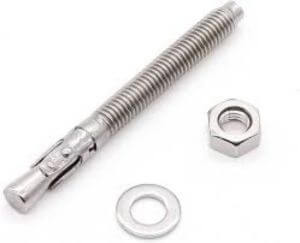
All bolts manufactured at LEMEC are produced to drawing and customer specification, in the materials, tolerances and finishes each application requires. If your part does not fit a standard type, we manufacture the custom solution.
Need help?
Contact our technical office and tell us about your project.
We will study your case and propose a solution to manufacture them.
Materials for bolt manufacturing
The material of a bolt determines its mechanical behaviour, environmental resistance and service life. At LEMEC we work with the main industrial metal alloys, selecting the material based on the real conditions of each application.
- Carbon steel: High mechanical strength and low cost. The most widely used in high-volume industrial runs.
- Stainless steel (AISI 316): Superior corrosion resistance in environments with moisture, chlorides or chemical agents. Standard in naval, food and defence applications.
- Aluminium: Lightweight with good corrosion resistance. Common in aeronautics and automotive where weight is a critical factor.
- Brass: Good electrical conductivity and corrosion resistance. Used in electronics and hydraulic installations.
- Titanium: Maximum mechanical strength with minimum weight. High-demand aerospace and medical applications.
- Bronze and copper: For applications with specific conductivity or wear resistance requirements.
At LEMEC we work with all the above alloys and manufacture in the material your application demands, always to drawing and customer technical specification.
Bolt manufacturing process
The quality of a bolt does not depend solely on the material — it depends on the process used to manufacture it. At LEMEC we use two processes depending on the volume and characteristics of each part.
Cold stamping
For long runs and high repeatability. The material is formed at room temperature using progressive presses, without removing material. The result is a part with greater mechanical strength than machining, better material utilisation and dimensional repeatability that meets the most demanding tolerances. It is the primary process for manufacturing bolts in industrial volumes.
CNC turning
For short or medium runs and geometries requiring greater flexibility. Allows bolts to be produced with complex details, tight tolerances and high-precision finishes in diameters up to 50 mm.
Both processes are carried out to the most demanding quality standards in the sector. LEMEC holds IATF 16949 certification for automotive and EN 9100 for aeronautics and defence, two of the most rigorous standards in industrial metal component manufacturing.
Sectors requiring industrial bolt manufacturing
Industrial bolts are present in any application where the joint must withstand high loads, continuous vibration or extreme environmental conditions. These are the sectors where bolts are regularly incorporated.
- Automotive Bodywork, suspension systems, transmissions and engines require bolts manufactured in long runs with strict tolerances and zero defects. LEMEC’s IATF 16949 certification guarantees compliance with the quality standards demanded by the automotive supply chain.
- Aeronautics and aerospace Aircraft structures require bolts with fatigue resistance, full material traceability and compliance with specific regulations. LEMEC manufactures to EN 9100, the reference standard for aerospace components.
- Defence Components for military vehicles, weapons systems and defence equipment where the reliability of the fixing element is non-negotiable. High mechanical strength, certified materials and full traceability.
- Naval Marine environments with constant exposure to chlorides and moisture require bolts in AISI 316 stainless steel or high corrosion-resistant alloys. LEMEC has experience supplying nautical structures and components.
- Industrial machinery Presses, hydraulic systems, lifting equipment and serial production machinery require bolts with high load capacity and durability in continuous service.
If your sector does not appear on this list, we most likely work with it anyway. At LEMEC we manufacture bolts for any industrial application requiring precision, volume and quality assurance.
Why outsource bolt manufacturing to LEMEC?
Manufacturing industrial bolts requires investment in tooling, precision machinery, quality control systems and sector certifications. For most companies, maintaining that capacity in-house is not cost-effective when the core business lies elsewhere.
Outsourcing bolt manufacturing to LEMEC means working with a supplier that operates exclusively to drawing and for third parties, no proprietary product, no conflict of interest. Every part we manufacture responds to the customer’s exact specifications.
What you get when working with LEMEC:
- Manufacturing from a few thousand parts to several million
- In-house engineering from the design phase to optimise the part before production
- Automated warehouse with customer tooling management
- IATF 16949 and EN 9100 certifications for the most demanding sectors
- Two available processes (cold stamping and CNC turning) depending on volume and geometry
If you need a specialist bolt manufacturer that works to your drawings, your materials and your deadlines, tell us about your project.
Get in touch with us
Contact our technical office and tell us what kind of steel parts you need to manufacture.
We will study your case and propose a customized, fast and efficient cold stamping solution.