CNC Screw Machining Equipment: The Technology Behind Every Precision Part
When an industrial company evaluates a screw machining supplier, the first question shouldn’t be how many parts they can produce, but what CNC screw machining equipment they use. The machinery defines achievable tolerances, viable geometries, and ultimately whether that supplier can meet the technical specifications on your drawing.
At Estampaciones Lemec, we have been manufacturing precision metal components for over 60 years. In this article, we show you what equipment we use in our plant and why it matters when choosing who manufactures your parts through screw machining.
Need help?
Contact our technical office and tell us about your project.
We will study your case and propose a solution to manufacture them.
What Is CNC Screw Machining Equipment and Why Does It Determine Quality
CNC screw machining equipment consists of automatic lathes driven by numerical control that machine parts directly from bar stock with minimal human intervention. Unlike older cam-operated lathes, these machines allow programming of complex geometries, tolerance control in the micron range, and consistent repeatability part after part, even in medium and long production runs.
Not all CNC lathes are the same. The headstock architecture, bed rigidity, number of axes, and control system determine what type of part can be reliably manufactured. That is why at Estampaciones Lemec we work with two world-leading platforms: Star Micronics and DMG MORI.
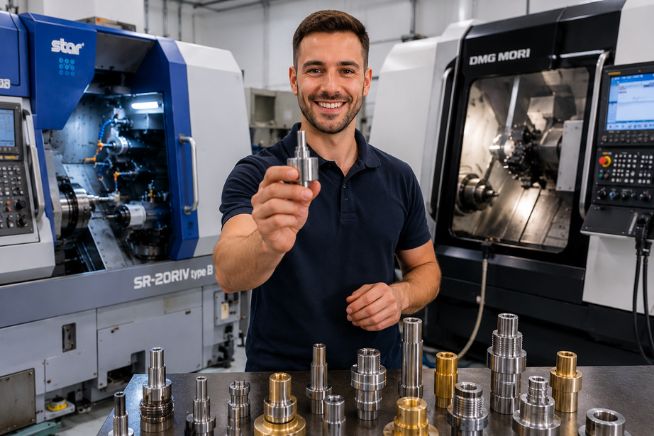
Sliding Headstock CNC Lathes: Star Micronics
Sliding headstock CNC lathes, also known as Swiss-type lathes, are the benchmark for slender, small-diameter parts requiring extreme-precision screw machining.
How They Work in Our Plant
At Estampaciones Lemec, we use STAR machines with the following capabilities:
- Meehanite cast iron bed that absorbs vibrations and maintains dimensional stability during extended cycles.
- Dovetail guides on the tool post, ideal for demanding cuts in stainless steels and tough materials.
- Step Cycle Pro system for chip breaking through synchronized vibration, enabling unattended 24/7 production without stops due to chip buildup.
- Ability to work with multiple tools simultaneously, reducing cycle times.
These are the machines we use to manufacture special screws, bushings, connectors, and small-diameter parts where material deflection would compromise quality on a conventional lathe.
Fixed Headstock CNC Lathes: DMG MORI
Fixed headstock CNC lathes are the solution for larger-diameter parts, robust geometries, and combined turning and milling operations in a single setup.
What They Bring to Our Production
In our plant, DMG MORI machines allow us to:
- Complete machining in a single setup, eliminating secondary operations and reducing errors from repositioning.
- MASTER family spindles with a 36-month warranty with no hour limit, ensuring stability and production continuity.
- CELOS digital management system, which optimizes setup times and enables full traceability of every batch.
- Capacity up to 92 mm diameter with automatic bar feeders, covering a wide range of series-produced parts.
The combination of DMG MORI fixed headstock with Star Micronics sliding headstock gives us a versatility that few screw machining workshops in Spain can offer.
Automatic Screw Machining Lathes: Why Having Both Architectures Matters
Many suppliers work with only one technology. Having automatic screw machining lathes in both configurations (fixed headstock and sliding headstock) means the customer does not need to source from two different suppliers or compromise part design due to machinery limitations.
At Estampaciones Lemec, this dual capability allows us to:
- Provide backing with IATF 16949, ISO 9001, and ISO 14001 certifications, ensuring traceability and quality in every batch.
- Manufacture parts from just a few millimeters up to 92 mm in diameter.
- Serve sectors with very different requirements: automotive, aerospace, industrial machinery, electronics, and marine.
Your Supplier’s Machinery Is Your Quality Guarantee
Before requesting a quote for CNC screw machining equipment, ask what brands and models your supplier uses. A workshop that is transparent about its technology is a workshop that trusts its capabilities. At Estampaciones Lemec, we open the doors of our plant because we know our Star Micronics and DMG MORI equipment speaks for itself.
If your company needs to outsource screw machining or is looking for a supplier with the right machinery to manufacture your parts with precision, contact our technical team and we will study your project with no obligation.
Does your project demand extreme precision?
Get in touch with us
Contact our technical office and tell us what kind of steel parts you need to manufacture.
We will study your case and propose a customized, fast and efficient cold stamping solution.