Types of metal pins
Types of metal pins play a fundamental role in mechanical engineering, manufacturing and construction. These small cylindrical or conical parts allow components to be fixed, aligned and secured with precision. Although they often go unnoticed, choosing the right one can make the difference between a safe assembly and one prone to failure, which is why turning to a specialized metal pin manufacturer is decisive for guaranteeing the precision and strength each application demands.
Most commonly used types of metal pins
Pins are classified according to their shape, function and installation system. The main ones are described below:
Cylindrical (or straight) pins
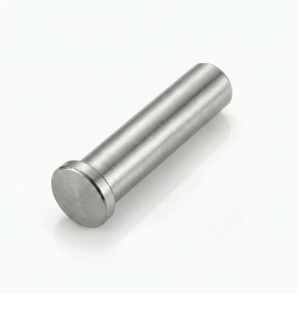
These are rods of uniform section, manufactured to strict tolerances (down to ±0.01 mm), which allow a precise interference fit. They are used to align components in machinery, engines or precision equipment. They are usually made of hardened steel, giving them a shear strength of up to 1200 MPa.
Conical (taper) pins
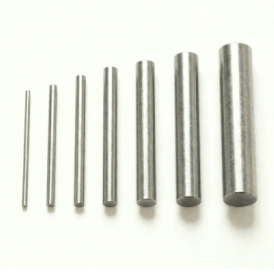
Wedge-shaped, with a decreasing diameter. Their insertion creates self-locking, facilitating precise alignments and easy disassembly. They are used in tools, dies or automotive machinery.
Cotter (or split) pins
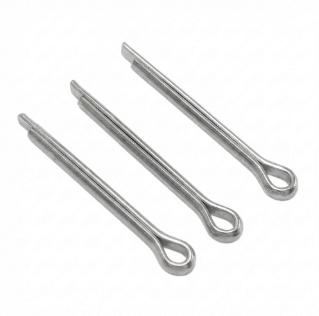
U-shaped clips that pass through holes and are bent to secure parts. Widely used in brake systems, suspension and agricultural machinery. Easy to install and inexpensive, although single-use and with limited strength (60-70 MPa).
Other pins
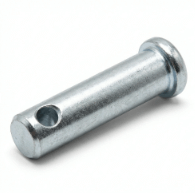
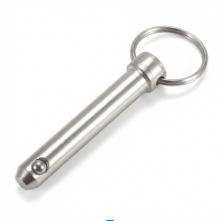
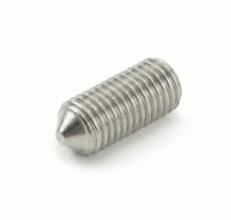
These include clevis pins (with a head and a hole for a cotter pin), threaded pins (pin + screw), and quick-release pins (bayonet type). They are used in pivoting or removable joints.
Need help?
Contact our technical office and tell us about your project.
We will study your case and propose a solution to manufacture them.
Common materials for metal pins
The most common materials include:
- Carbon steel: High strength and low cost.
- Stainless steel: Ideal for corrosive environments.
- Brass: Good conductivity and corrosion resistance.
- Aluminum: Lightness and protection against oxidation.
- Titanium: High strength-to-weight ratio and biocompatibility.
- Special alloys: Such as copper-beryllium for electrical or sanitary applications.
Manufacturing process for types of pins
The choice of process depends on the type of pin, production volume and technical requirements:
Cold heading
Used for split and spring pins. It involves stamping and forming the material using presses. It is fast and cost-effective for large volumes.
Screw machining
Ideal for high-precision cylindrical or conical pins. It is carried out using automatic lathes that machine metal bars to very strict tolerances.
How to choose the right type of pin?
This will depend on the type of joint, load, ease of assembly/disassembly, working environment and budget. For example:
- High-precision applications: cylindrical pins.
- Environments with vibration: spring pins.
- Temporary or low-cost joints: cotter pins.
- Need for frequent disassembly: clevis pins.
Comparison of pin types
| Pin type | Advantages | Disadvantages | Typical use |
|---|---|---|---|
| Cylindrical | High precision, shear resistance | Demanding installation, difficult to remove | Engines, molds, tooling |
| Conical | Self-locking, easy to remove | Requires a special hole | Tools, alignments |
| Spring (elastic) | Self-adjusting, absorbs vibration | Lower load capacity, difficult to remove | Agricultural machinery, transmissions |
| Cotter (split) | Economical, quick to install | Low load capacity, single-use | Automotive, brakes, suspension |
Suppliers and custom manufacturing (including LEMEC)
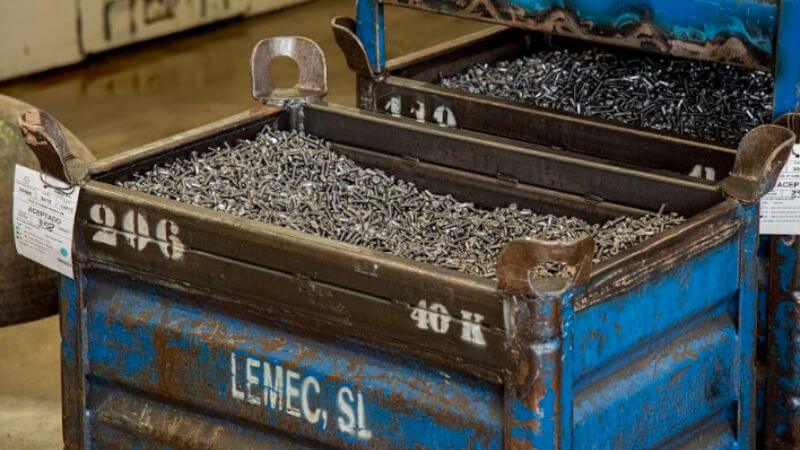
Companies such as LEMEC, specialized in cold stamping and screw machining, handle the manufacturing of metal parts, such as custom metal pins made to drawing or to the customer’s technical requirements. The ability to work with different materials and guarantee tight tolerances is key in sectors such as automotive, aerospace or machinery.
Having a trusted supplier makes it possible to optimize time and costs while ensuring the quality of the manufactured parts.
Get in touch with us
Contact our technical office and tell us what kind of steel parts you need to manufacture.
We will study your case and propose a customized, fast and efficient cold stamping solution.