Manufacturing of Aeronautical Pins
Discussing aeronautical pins is not a matter of a simple mechanical element. In the aerospace industry, every structural component is subjected to extreme demands in terms of load, vibration, fatigue and thermal variation. A pin may be small in size, but its impact on the structural safety of an aircraft is critical.
Understanding their design is essential for any professional in the aerospace sector. Knowing what pins are used for in aviation, how they affect structural integrity and what distinguishes a certified component enables sound technical and strategic decisions.
What Are Aeronautical Pins
An aeronautical pin is a cylindrical joining element designed primarily to withstand shear loads (transverse cutting) between two or more structural components.
Unlike screws or bolts, they do not work through threaded friction, but through direct shear resistance.
In aerospace environments, an aerospace pin must meet:
- Extremely tight dimensional tolerances
- Full material control and traceability
- High fatigue resistance
- Galvanic compatibility with mixed-material structures
When it comes to aeronautical pins, the concept of a “standard industrial part” does not apply. Every component must be designed and manufactured in accordance with specific regulations and certification criteria.
Need help?
Contact our technical office and tell us about your project.
We will study your case and propose a solution to manufacture them.
What Are Pins Used for in Aviation
Understanding what pins are used for in aviation means understanding their structural relevance.
In civil and military aircraft, pins for aeronautical applications fulfil critical functions such as:
1. System Articulation
- Landing gear (pivots and trunnions)
- Control surfaces (ailerons, rudder, elevators)
- Hydraulic actuators
These elements allow controlled movement under load without generating premature wear.
2. Locking and Safety
This is where locking pins and positive safety systems come in, used for:
- Landing gear locking during maintenance
- Temporary securing of critical mechanisms
- Ejection systems in military aviation
Many professionals search specifically for what locking pins are in aeronautics, as their function is to prevent accidental movement under intense vibration.
3. Structural Positioning
In primary structural joints, they eliminate any clearance that could generate fretting or accelerated fatigue.
Types of Pins in the Aeronautical Industry
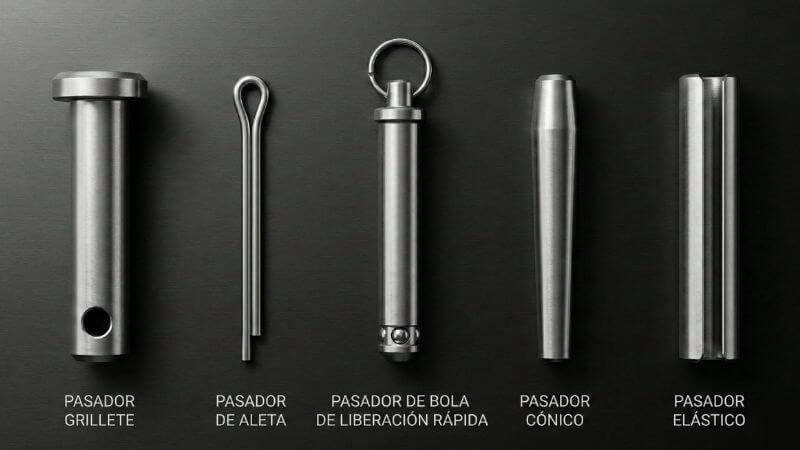
Different types of pins exist in the aeronautical industry, each optimised for a specific function.
Clevis Pins
- Allow controlled rotation
- Combined with safety cotter keys
- Frequently used in control systems
Cotter Pins
- Secondary safety element
- Non-reusable
- Used with castellated nuts
Quick Release / Ball Lock Pins
- Retractable ball system
- Fast installation and removal
- Very common in ground support equipment and access panels
Taper Pins
- Zero-clearance fit
- Ideal for continuous shear loads
Roll / Spring Pins
- Secondary load applications
- Limited use in non-critical structural components
Correct type selection depends on load, vibration, accessibility and applicable regulations.
Materials Used for Aeronautical Pins
The materials used for pins determine their behaviour under load, corrosion and temperature.
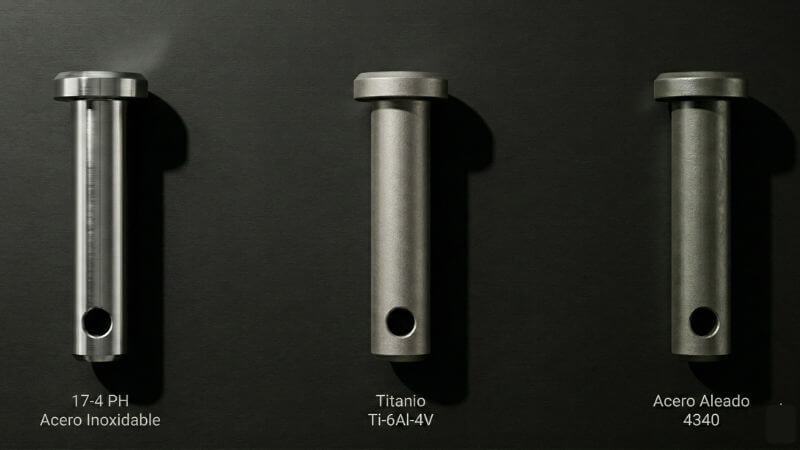
17-4 PH Stainless Steel
- Precipitation hardened
- High shear resistance
- Excellent corrosion resistance
Titanium (Ti-6Al-4V)
- High strength-to-weight ratio
- Ideal where weight reduction is a priority
Alloy Steel 4130 / 4340
- High mechanical strength
- Requires protective coatings
Common Surface Treatments
- Zinc-nickel plating
- Passivation
- Specific heat treatments
Material selection depends on the operating environment, load cycles and regulatory requirements.
Applicable Standards and Certifications
Aeronautical pins are governed by strict standards that ensure safety and interchangeability.
AN (Air Force – Navy)
Historical standards still widely used.
MS (Military Standard)
Standardisation from the U.S. Department of Defense.
NAS / NASM (National Aerospace Standards)
Represent a higher level of technical requirement.
MIL-SPEC
Defines specific physical and operational requirements, including vibration testing.
In addition, quality management systems such as AS9100 and full documentary traceability requirements must be considered in Europe.
Manufacturing of Aeronautical Pins: Precision and Cold Forming
The manufacture of aeronautical pins demands advanced industrial processes.
Key requirements include:
- Dimensional control in microns
- Controlled heat treatments
- Non-destructive inspection
- Repetitive production with zero tolerance
Precision cold forming enables:
- Efficient high-volume production
- High dimensional repeatability
- Optimised material utilisation
- Cost reduction compared to full machining
For manufacturers, government bodies and the defence sector in Spain, working with specialists in high-precision industrial processes is decisive in guaranteeing safety and competitiveness.
How to Choose an Aeronautical Pin Supplier in Spain
If the objective is to find a manufacturer or industrial partner, these are the key criteria:
- Experience in the aeronautical or defence sector
- Knowledge of AN, MS and NAS standards
- Series production capability
- Full documentary traceability
- Certified quality control
Selecting the right supplier is not merely an economic decision. it is a strategic one, essential for ensuring safety and regulatory compliance.
Precision Is Not Optional in the Aeronautical Industry
In aviation, every component fulfils a critical structural function. Aeronautical pins must be designed, selected and manufactured to standards that eliminate any margin for error.
From material selection to series production through processes such as cold forming, every phase directly influences the safety of the complete system. In an environment where traceability and certification are mandatory, working with a specialised such as LEMEC makes the difference between an industrial part and a certified aeronautical component.
Get in touch with us
Contact our technical office and tell us what kind of steel parts you need to manufacture.
We will study your case and propose a customized, fast and efficient cold stamping solution.