Manufacturing of components for boat masts
In the nautical industry, the manufacturing of components for boat masts requires highly precise processes and materials with superior mechanical properties. One of the most efficient and reliable methods for producing these elements in long runs is cold heading and screw machining of stainless steel bars, especially in 316/A4 grade, for its exceptional resistance to tensile stress and marine corrosion.
What are nautical metal components for masts?
Boat masts require a variety of metal fastening elements, manufactured to strict tolerances and with guaranteed mechanical strength. These components are vital for maintaining the structure and integrity of the rigging.
Types of components:
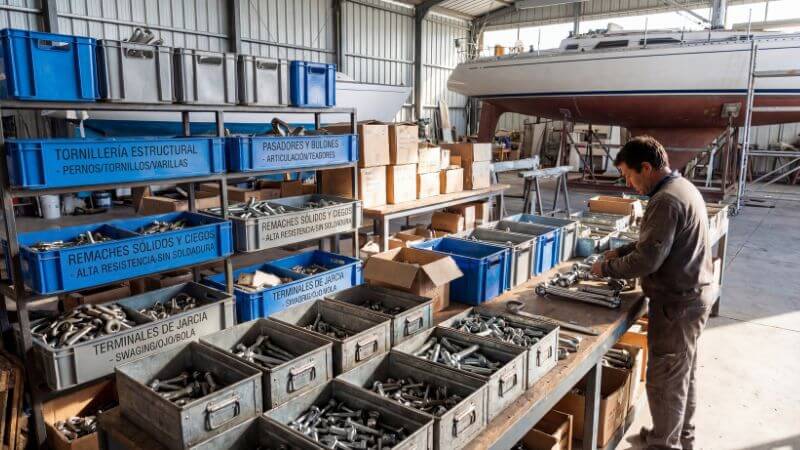
- Structural fasteners for boats: bolts, screws and threaded rods, with heads formed by cold heading.
- Pins and clevis bolts: articulation elements such as clevis pins and turnbuckle pins.
- Stainless rivets for nautical use, both solid and blind: manufactured from bar, without welds, with high fatigue resistance.
- Rigging terminals: eye, ball, fork terminals, etc., fixed to the cable by swaging.
Need help?
Contact our technical office and tell us about your project.
We will study your case and propose a solution to manufacture them.
Suitable materials: 316/A4 stainless steel and naval steel
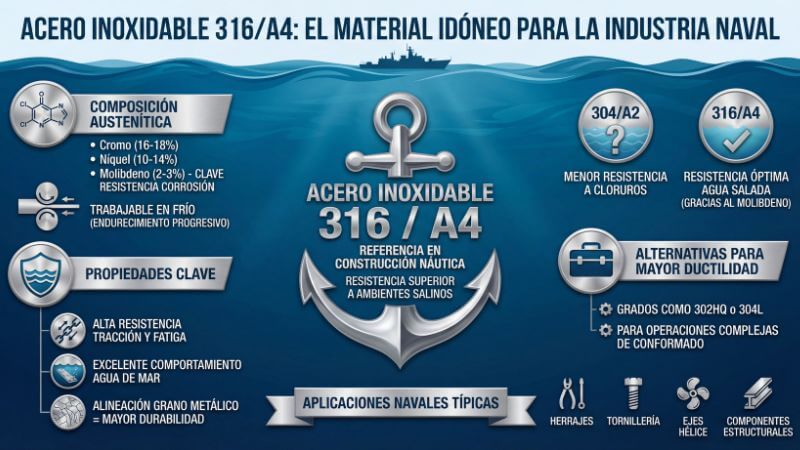
316/A4 stainless steel is the reference material in nautical construction for its ability to withstand saline environments without requiring additional coatings. Its austenitic composition allows it to be cold worked, although with progressive hardening.
Key properties:
- High tensile and fatigue strength.
- Excellent behavior in prolonged contact with seawater.
- Alignment of the metal grain after forming, which increases durability.
Other grades such as 302HQ or 304L are used when greater ductility is needed for complex operations.
Manufacturing processes for boat mast components
To achieve high-quality nautical components in large quantities, two key industrial processes are applied:
Cold heading
It involves applying progressive blows to metal rod at room temperature to form heads, recesses and other geometries.
Advanges:
- Preserves grain continuity.
- Improves mechanical strength without heat treatments.
- High production speed (up to 35,000 parts/hour).
- Minimal material waste.
Screw machining
Automatic bar machining technique, ideal for cylindrical geometries with precise details. Complements stamping for parts with special finish or tolerance requirements.
Advantages of choosing a supplier specialized in naval steel components
Choosing a supplier that masters both processes ensures:
- Dimensional consistency in every batch.
- Cost reduction thanks to automation.
- Material traceability and quality controls: crack detection with Eddy current testing, dimensional verification, and destructive testing on samples.
- Compliance with international material standards (EN/ASTM).
Uses of metal components in boats
The following products, manufactured in long runs by cold heading and screw machining, are used in mast structures:
- Threaded stays and splice bolts: for mast joints.
- Structural rivets for boats: used in metal panels.
- Rigging terminals: balls, eyes and forks swaged to the cable.
- Hinge pins: critical articulation elements.
How to evaluate a supplier for long-run manufacturing
Before choosing a supplier for nautical components:
- Verify that they have multi-station stamping machinery (up to 7 stations).
- Confirm experience with 316/A4 stainless steel and cold hardening processes.
- Request quality inspection documentation and material reports.
- Assess large-volume delivery capacity, with fast cycle times.
Request manufacturing of metal nautical elements in long runs
If you need a reliable supplier for the series manufacturing of fastening elements for masts, LEMEC offers expertise in cold heading and screw machining, with automated production, certified materials and precision finishing.
Contact us today for technical advice and a quote tailored to your volume needs.
Get in touch with us
Contact our technical office and tell us what kind of steel parts you need to manufacture.
We will study your case and propose a customized, fast and efficient cold stamping solution.