Types of washers and their functions in fastening systems
Loosening under vibration, deformation of the base material, corrosion between dissimilar metals or loss of sealing. These common failures in bolted joints originate from an apparently minor decision: which type of washer to place between the fastener and the surface.
In sectors such as automotive, aeronautics or industrial machinery, choosing the correct washer is a technical decision with direct consequences on the reliability of the assembly.
Below we explain the main types of washers, the function each one performs, the materials they are manufactured in and how they are produced by cold stamping.
What is a washer and what is it used for
A washer is a metallic (or polymeric) disc with a central hole placed between the head of the bolt (or nut) and the bearing surface. Its primary function is to distribute the clamping load over a larger area to prevent the fastener from damaging or deforming the base material.
Depending on its design, a washer can also prevent loosening under vibration, seal the joint against liquids or gases, electrically isolate two metals to prevent galvanic corrosion, or compensate for surfaces that are not perfectly parallel.
Types of washers and when to use them
The most practical way to classify washers is by the problem they solve: vibration, load, sealing or insulation. This allows you to start from the technical requirement and arrive at the specific type.
Load bearing and distribution washers
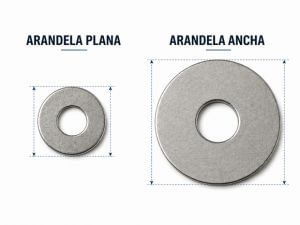
The flat washer (DIN 125) is the most common type in industry. It is placed under the bolt head or nut to distribute clamping pressure and protect the surface. For soft materials or oversized holes, the wide/Fender washer (DIN 9021) is used, offering a larger contact surface.
Safety and locking washers
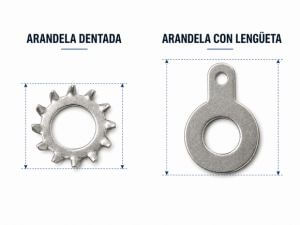
Prevent the bolt or nut from rotating and loosening. Toothed washers (external or internal toothing) bite into the bearing surface when tightened. Tab washers lock by bending a tab against the bolt or nut. Circlips or Seeger rings sit in shaft grooves to prevent axial displacement of components such as bearings or gears.
Spring and pressure washers
Designed to maintain joint tension in environments subject to vibration or thermal cycling.
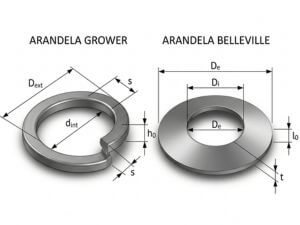
The Grower washer (DIN 127) is a helical ring that generates friction when compressed, effective for moderate vibration. The Belleville washer (DIN 6796) is a conical disc that acts as a spring and compensates for thermal expansion. Wave washers dampen minor vibrations.
Sealing and gasketing washers
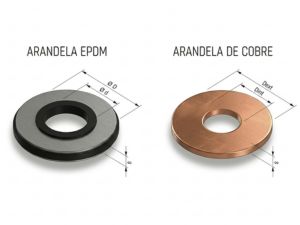
Combine a metallic component with an elastomer to create a hermetic seal. EPDM washers (steel and vulcanised rubber) prevent water ingress in roofing, industrial facades and electrical enclosures. Copper or aluminium washers function as gaskets in hydraulic and pneumatic circuits.
Need help?
Contact our technical office and tell us about your project.
We will study your case and propose a solution to manufacture them.
Materials used for washer manufacturing
The washer material must be compatible with the fastening element and the working environment.
- Carbon steel: high mechanical strength and low cost. The most widely used in general machinery and automotive.
- Stainless steel A2 (AISI 304): corrosion resistant for outdoor use, food industry and humid environments.
- Stainless steel A4 (AISI 316): superior resistance to chlorides and chemicals. Standard in naval, offshore and chemical plant sectors.
All materials accept surface treatments such as zinc plating, galvanising or phosphating depending on service conditions. For other materials or specific requirements, manufactured on request.
Industrial applications of washers
Washers are present in virtually all industrial sectors, but technical requirements vary according to the working environment and applicable regulations.
- Automotive: safety and toothed washers in chassis, transmissions and braking systems. Manufactured under IATF 16949 with JIT supply.
- Aeronautics and defence: Belleville and wave washers in joints subject to thermal fatigue. Full traceability under EN 9100.
- Naval sector: A4 stainless and sealing washers for saline environments and chloride exposure.
- Renewable energy: galvanised structural washers in wind towers and solar panel structures with long-term durability requirements.
- Industrial machinery and railway: large-format Grower and Belleville washers for joints subject to vibration and mechanical fatigue in continuous service.
The choice of washer type, material and surface treatment depends directly on the sector and the service conditions of each application.
Reference table: washer types, standards and applications
The following table summarises the main washer types, their DIN/ISO reference standards, primary function and typical application. It can serve as a quick reference guide to identify the appropriate washer according to the technical requirements of the project.
| Washer type | DIN standard | Primary function | Typical application |
|---|---|---|---|
| Flat (standard series) | DIN 125 | Load distribution | Universal |
| Flat (wide series) | DIN 9021 | Support on soft materials | Panels, wood, composites |
| Structural | DIN 7989 / DIN 6916 | High load | Steel construction |
| Grower (helical) | DIN 127 | Anti-loosening by friction | Machinery, automotive |
| Belleville (conical) | DIN 6796 / DIN 2093 | Thermal compensation and preload | Engines, generators |
| External toothed | DIN 6797 | Locking by penetration | Appliances, electronics |
| Internal toothed | DIN 6798 | Locking in confined space | Compact assemblies |
| Tab washer | DIN 93 / DIN 432 | Mechanical locking | Critical joints |
| Oblique wedge | DIN 434 / DIN 435 | Surface compensation | U and I section profiles |
| Seeger (circlip) | DIN 471 / DIN 472 | Axial retention | Shafts, bearings |
LEMEC: washer manufacturing by cold stamping
Cold stamping forms the material (wire rod or metal strip) in progressive presses at room temperature, allowing high production speeds, minimal waste and consistent dimensional precision. Spring washers (Grower, Belleville) receive a subsequent heat treatment of hardening and tempering to obtain their spring properties.
At Estampaciones LEMEC we have manufactured washers by cold stamping and CNC turning since 1962. Our plant in Albuixech (Valencia) produces parts in series with a quality system backed by four certifications: ISO 9001, IATF 16949 for automotive, EN 9100 for aeronautics and defence, and ISO 14001 for environmental management. This combination enables us to supply washers to sectors with the most demanding quality requirements on the market.
We manufacture standard and custom washers, adapted to the technical requirements of each project: special geometries, specific materials and non-standard tolerances. If you need washers for a specific industrial application, request a no-obligation quote.
Get in touch with us
Contact our technical office and tell us what kind of steel parts you need to manufacture.
We will study your case and propose a customized, fast and efficient cold stamping solution.